
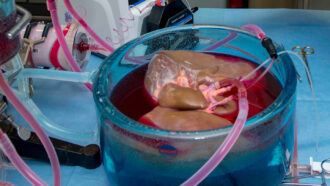
The icy world of organ freezing – Science News, August 19, 1972
If whole organs could be frozen and stored … surgeons would be able to perform far more transplants…. For all their efforts, though, cryobiologists (biologists who study the effects of cold on life) have not been very successful with organ freezing…. Nobody to date has cooled whole mammalian hearts any lower [than −20° Celsius] or longer [than six hours] and revived them.
Update
Scientists still struggle to keep donor hearts on ice for longer than six hours, but it is now possible to store a different organ — the liver — at below-freezing temperatures for more than a day. The challenge has been figuring out how to stop ice from crystallizing and damaging cells. In 2019, scientists reported successfully warming up several human livers after supercooling them for 27 hours (SN: 10/12/19 & 10/26/19, p. 10). This and other preservation methods such as freezing at high pressures or thawing using nanoparticles aren’t yet ready for the operating room, but they have the potential to keep thousands of lifesaving organs from going to waste each year.
 Horned dinosaurs’ weapons evolved to handle the forces of combat
  Artemis II results show how much science people can do at the moon
  Crossword: Time lines
  Many American diets may not include enough of this essential nutrient
  A telling hole in a Neandertal bone hints at a bitter end
  Brain implants are helping people who’ve lost their voice
  WHO scales up Ebola readiness in 22 countries across three continents
  Ukraine: Civilian casualty rates among ‘deadliest’ in years, as energy attacks intensify
  As disasters mount, next UN climate summit faces a test of trust
  Gaza: 340 children killed despite ceasefire agreement – UNICEF