
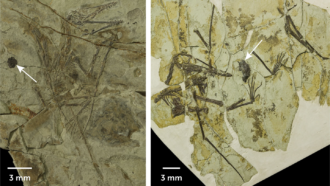
Picture it: Two hungry pterosaurs, one adult and one juvenile, settle down to dig in to a delicious lunch of fish. Down their gullets the whole fish go. A little later, back up come the scales and other indigestible fishy bits, vomited neatly as millimeter-sized pellets.
Scientists now have the first fossilized evidence that pterosaur dining included a final course of regurgitation, scientifically called antiperistalsis. While studying two specimens of Kunpengopterus sinensis, a pterosaur species that lived in what is now China between 199 million and 146 million years ago, researchers found a gastric pellet containing fossilized fish scales preserved alongside each individual, they report February 7 in Philosophical Transactions of the Royal Society B.
That pterosaurs gave those inedible bits the old heave-ho isn’t a surprise. The flying reptiles’ family tree is full of gastric pellet–expelling species, from living birds such as owls and gulls to fossilized cousins like ancient crocodilians and non-avian dinosaurs.
But the study does help flesh out what little is known about pterosaur diet and digestion (SN: 7/22/21). It reveals that members of this species, at least, were fish eaters. (Other possibly tree-climbing members of the genus Kunpengopterus may have dined on insects (SN: 4/14/21).) The find also suggests that, like modern birds, these pterosaurs had two-part stomachs: an acid-secreting part to dissolve the food, and a muscular gizzard to compact the indigestible bits into a pellet.
Based on the size of the scales in the larger pellet, found next to the adult, the fish it was eating was much larger than most fish fossils found at the site, the researchers note. That suggests that rather than opportunistically scavenging any fish that washed up onshore, K. sinensis may have been a hunter, actively choosing the largest prey it could catch.
 Was the ‘American cheetah’ a cheetah at all?
  AI agents aren’t ready to replace humans in behavioral research
  A culprit for corrosion may have been operating under our noses
  New Hubble images reveal a bizarre decagon over Saturn’s south pole
  A massive study unveils the genetic underpinnings of fibromyalgia
  The universe may have been building rocky planets almost from the start
  As wildfires spread north, UN agencies race to help Europe adapt
  Central Park adapts to climate change while helping New York stay cool
  UN aims to raise nearly $50 million for Nepal flood response
  West Bank: UN rights report warns of forcible displacement from three refugee camps