
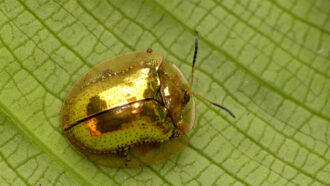
This is a story about camouflage, but forget mud-blob brown, mealy beige and somber green. Here scientists study mirror glitz and the paradoxical notion that there’s a shiny side to camo.
Mirrorlike surfaces have evolved in open-ocean fishes as well as in spiders, butterfly chrysalises and most branches of the vast diversity of beetles, says visual ecologist Amanda Franklin of the University of Melbourne. One popular idea proposes that these living mirrors might confound predators by reflecting water, leaves, twigs or whatever.
For a test of dry-land mirrors, Franklin and her colleagues turned to a showy group of about 40 species of scarab beetles, some with a natural gleam. In golds, bronzes, greens and blues, they climb into eucalyptus trees to flirt and mate during their native Australia’s high summer in December. “People love Christmas beetles,” Franklin says.
To see if good reflection gives protection, Franklin set out to create nubs of clay roughly the shape of two greenish Christmas beetles, one with a mirror finish and one matte like their real-life counterparts, Anoplognathus parvulus (shiny) and A. prasinus (dull).
Creating a “brushed-metal” look was easy, but she needed fake beetles with a full muscle car metal shine. Also she needed something fast to make. “If you have to sand it all day, you’re not going to be able to make a thousand,” Franklin says.
But prototype after prototype failed to shine. After about six weeks of frustration, “we probably had hundreds in the throw-out bin.” Working with a specialist in a hobby shop where her father for years bought supplies for making model World War II planes finally cracked the mirror mystery.
The trick to beetle-grade reflectivity turned out to be finding just the right super-smooth resin to coat the models before spray-painting. Then just a bit of sanding the shiny models approximated the relative difference between the mirror species and its drabber relative.
Franklin and her colleagues then set out more than a thousand models for six days in two regions of Australia and in both leafy and open areas. In areas with such beetle eaters as butcherbirds and cuckoo-shrikes, the researchers checked for beak marks indicating bird attacks. The mirror finish, however, didn’t show a clear benefit, Franklin and colleagues reported in the January 2022 Functional Ecology. The soft “bodies” of the glossy fakes had just about as many gashes and dings from bird strikes as the matte finish models did.
A test with people as pretend predators wearing eye-tracker rigs also failed to show that shiny things were harder to find than the scuffed, duller beetles. All faux beetles at least avoided being hungrily speared once spotted. “The benefit is that you can tell a human what to do,” Franklin says.
Mirror camo might still work in some predicaments, but Franklin is now wondering if the big advantage of mirror bodies perhaps has little to do with their looks. The complicated microstructures that create the mirrors might, for instance, reduce the danger of cracks or fungal cooties. Homo sapiens fixates on looks, but maybe the visual thrill of a Christmas beetle’s mirror is just a holiday bonus.
 Was the ‘American cheetah’ a cheetah at all?
  AI agents aren’t ready to replace humans in behavioral research
  A culprit for corrosion may have been operating under our noses
  New Hubble images reveal a bizarre decagon over Saturn’s south pole
  A massive study unveils the genetic underpinnings of fibromyalgia
  The universe may have been building rocky planets almost from the start
  As wildfires spread north, UN agencies race to help Europe adapt
  Central Park adapts to climate change while helping New York stay cool
  UN aims to raise nearly $50 million for Nepal flood response
  West Bank: UN rights report warns of forcible displacement from three refugee camps