
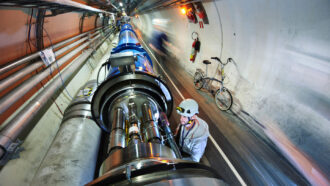
After a hiatus of more than three years, the Large Hadron Collider is back.
Scientists shut down the particle accelerator in 2018 to allow for upgrades (SN: 12/3/18). On April 22, protons once again careened around the 27-kilometer-long ring of the Large Hadron Collider, or LHC, located at the particle physics laboratory CERN in Geneva.
The LHC is coming out of hibernation gradually. Researchers started the accelerator’s proton beams out at relatively low energy, but will ramp up to slam protons together at a planned record-high energy of 13.6 trillion electron volts. Previously, LHC collisions reached 13 trillion electron volts. Likewise, the beams are starting out wimpy, with relatively few protons, but will build to higher intensity. And when fully up to speed, the upgraded accelerator will pump out proton collisions more quickly than in previous runs. Experiments at the LHC will start taking data this summer.
Physicists will use this data to further characterize the Higgs boson, the particle discovered at the LHC in 2012 that reveals the source of mass for elementary particles (SN: 7/4/12). And researchers will be keeping an eye out for new particles or anything else that clashes with the standard model, the theory of the known particles and their interactions. For example, researchers will continue the hunt for dark matter, a mysterious substance that so far can be observed only by its gravitational effects on the cosmos (SN: 10/25/16).
After several years of operations, the LHC will shut down again to prepare the High-Luminosity LHC (SN: 6/15/18), which will further boost the rate of proton collisions and allow for even more detailed studies of the fundamental constituents of matter.
 Was the ‘American cheetah’ a cheetah at all?
  AI agents aren’t ready to replace humans in behavioral research
  A culprit for corrosion may have been operating under our noses
  New Hubble images reveal a bizarre decagon over Saturn’s south pole
  A massive study unveils the genetic underpinnings of fibromyalgia
  The universe may have been building rocky planets almost from the start
  UN aims to raise nearly $50 million for Nepal flood response
  West Bank: UN rights report warns of forcible displacement from three refugee camps
  UN tells the world: Stop making Africa look small
  Repeated attacks on humanitarian warehouses put vital medical aid at risk in Ukraine: WHO