
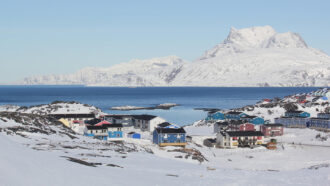
The Arctic is heating up at a breakneck speed compared with the rest of Earth. And new analyses show that the region is warming even faster than scientists thought. Over the last four decades, the average Arctic temperature increased nearly four times as fast as the global average, researchers report August 11 in Communications Earth & Environment.
And that’s just on average. Some parts of the Arctic Ocean, such as the Barents Sea between Russia and Norway’s Svalbard archipelago, are warming as much as seven times as fast, meteorologist Mika Rantanen of the Finnish Meteorological Institute in Helsinki and colleagues found. Previous studies have tended to say that the Arctic’s average temperature is increasing two to three times as fast as elsewhere, as humans continue causing the climate to change.
To calculate the true pace of the accelerated warming, a phenomenon called Arctic amplification, the researchers averaged four sets of satellite data from 1979 to 2021 (SN: 7/1/20). Globally, the average temperature increase over that time was about 0.2 degrees Celsius per decade. But the Arctic was warming by about 0.75 degrees C per decade.
Even the best climate models are not doing a great job of reproducing that warming, Rantanen and colleagues say. The inability of the models to realistically simulate past Arctic amplification calls into question how well the models can project future changes there.
It’s not clear where the problem lies. One issue may be that the models are struggling with correctly simulating the sensitivity of Arctic temperatures to the loss of sea ice. Vanishing snow and ice, particularly sea ice, are one big reason why Arctic warming is on hyperspeed. The bright white snow and ice create a reflective shield that bounces incoming radiation from the sun back into space. But open ocean waters or bare rocks absorb that heat, raising the temperature.
 Horned dinosaurs’ weapons evolved to handle the forces of combat
  Artemis II results show how much science people can do at the moon
  Crossword: Time lines
  Many American diets may not include enough of this essential nutrient
  A telling hole in a Neandertal bone hints at a bitter end
  Brain implants are helping people who’ve lost their voice
  WHO scales up Ebola readiness in 22 countries across three continents
  Ukraine: Civilian casualty rates among ‘deadliest’ in years, as energy attacks intensify
  As disasters mount, next UN climate summit faces a test of trust
  Gaza: 340 children killed despite ceasefire agreement – UNICEF