
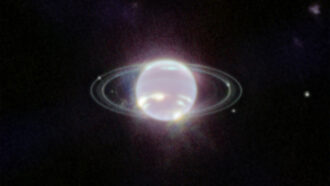
Humankind is seeing Neptune’s rings in a whole new light thanks to the James Webb Space Telescope.
In an infrared image released September 21, Neptune and its gossamer diadems of dust take on an ethereal glow against the inky backdrop of space. The stunning portrait is a huge improvement over the rings’ previous close-up, which was taken more than 30 years ago.
Unlike the dazzling belts encircling Saturn, Neptune’s rings appear dark and faint in visible light, making them difficult to see from Earth. The last time anyone saw Neptune’s rings was in 1989, when NASA’s Voyager 2 spacecraft, after tearing past the planet, snapped a couple grainy photos from roughly 1 million kilometers away (SN: 8/7/17). In those photos, taken in visible light, the rings appear as thin, concentric arcs.
As Voyager 2 continued to interplanetary space, Neptune’s rings once again went into hiding — until July. That’s when the James Webb Space Telescope, or JWST, turned its sharp, infrared gaze toward the planet from roughly 4.4 billion kilometers away (SN: 7/11/22).
Neptune itself appears mostly dark in the new image. That’s because methane gas in the planet’s atmosphere absorbs much of its infrared light. A few bright patches mark where high-altitude methane ice clouds reflect sunlight.
And then there are the ever-elusive rings. “The rings have lots of ice and dust in them, which are extremely reflective in infrared light,” says Stefanie Milam, a planetary scientist at NASA’s Goddard Space Flight Center in Greenbelt, Md., and one of JWST’s project scientists. The enormity of the telescope’s mirror also makes its images extra sharp. “JWST was designed to look at the first stars and galaxies across the universe, so we can really see fine details that we haven’t been able to see before,” Milam says.
Upcoming JWST observations will look at Neptune with other scientific instruments. That should provide new intel on the rings’ composition and dynamics, as well as on how Neptune’s clouds and storms evolve, Milam says. “There’s more to come.”
 Scientists may have seen dark matter. If they did, what exactly is it?
  A ‘phoenix’ planet was born from the ashes of its dead star
  Astronomers say they’ve spotted the first miniature quasar pointed at Earth
  Young Yosemite toads survive winter, then emerge with a deadly fungus
  Are hypernovas real?
  Here’s how brain-eating amoebas may infect people
  One day behind bars: Students and incarcerated women break prison stigma in Thailand
  Sudan: Driver killed in aerial attack on aid trucks in South Kordofan
  UN upholds housing as a human right on World Habitat Day