
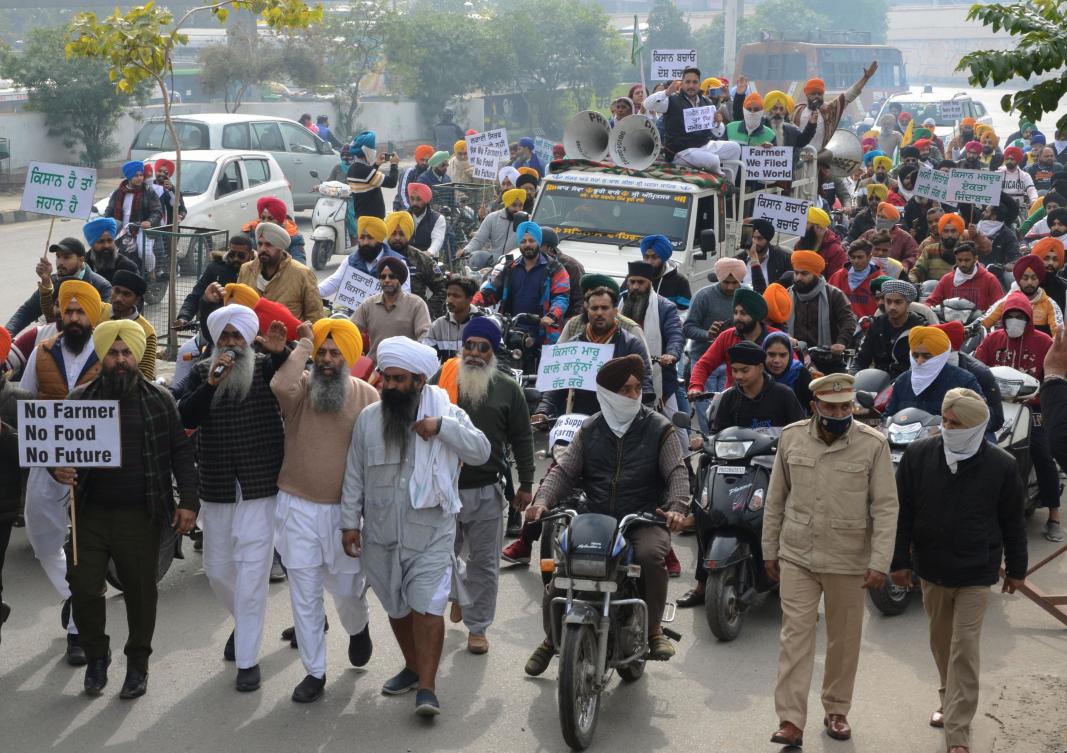
NEW DELHI: Tens of thousands of protesting Indian farmers have called for a national strike on Monday, the second in a week, to press for the quashing of three new laws on agricultural reform that they say will drive down crop prices and devastate their earnings.
The farmers are camping along at least five major highways on the outskirts of New Delhi and have said they won’t leave until the government rolls back what they call the “black laws.” They have blockaded highways leading to the capital for three weeks, and several rounds of talks with the Indian government have failed to produce any breakthroughs.
Farmer leaders have also planned a token hunger strike on Monday. Heavy contingents of police in riot gear patrolled the areas where the farmers have been camping in New Delhi’s outskirts.
Protest leaders have rejected the government’s offer to amend some contentious provisions of the new farm laws, which deregulate crop pricing, and have stuck to their demand for total repeal.
Farmer leaders have threatened to intensify their agitation and threatened to block trains in the coming days if the government doesn’t abolish the laws.
The farmers filed a petition with the Supreme Court on Friday seeking the quashing of the laws, which were passed in September. The petition was filed by the Bharatiya Kisan Union, or Indian Farmers’ Union, and its leader, Bhanu Pratap Singh, who argued that the laws were arbitrary because the government enacted them without proper consultations with stakeholders.
Five round of talks between the government and farmers since November have failed to halt the blockade, with the protesters continuing to insist that the laws be repealed.
Agriculture Minister Narendra Singh Tomar said Thursday that the government was willing to amend the laws to allay the farmers’ concerns, but that they should give up their insistence on scrapping them.
The farmers fear the government will stop buying grain at minimum guaranteed prices and corporations will then push prices down. The government says it is willing to pledge that guaranteed prices will continue.
With nearly 60 percent of the Indian population depending on agriculture for their livelihoods, the growing farmer rebellion has rattled Prime Minister Narendra Modi’s administration and its allies.
Modi’s government insists the reforms will benefit farmers. It says they will allow farmers to market their produce and boost production through private investment.
Farmers have been protesting the laws for nearly two months in Punjab and Haryana states. The situation escalated three weeks ago when tens of thousands marched to New Delhi, where they clashed with police.

India’s Modi says government committed to farmers’ welfareTalks between protesting farmers and Indian government fail again
 Was the ‘American cheetah’ a cheetah at all?
  AI agents aren’t ready to replace humans in behavioral research
  A culprit for corrosion may have been operating under our noses
  New Hubble images reveal a bizarre decagon over Saturn’s south pole
  A massive study unveils the genetic underpinnings of fibromyalgia
  The universe may have been building rocky planets almost from the start
  Trump’s “Comprehensive” Gaza Peace Plan a Cover for Genocide
  Beyond the Death Penalty Debate: Human Dignity and Justice in Japan
  What 1.5°C Overshoot Means for Small Islands
  Coordinated action on clean air and climate change can net $15 for every dollar spent