
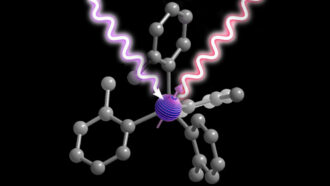
Quantum bits made from “designer molecules” are coming into fashion. By carefully tailoring the composition of molecules, researchers are creating chemical systems suited to a variety of quantum tasks.
“The ability to control molecules … makes them just a beautiful and wonderful system to work with,” said Danna Freedman, a chemist at Northwestern University in Evanston, Ill. “Molecules are the best.” Freedman described her research February 8 at the annual meeting of the American Association for the Advancement of Science, held online.
Quantum bits, or qubits, are analogous to the bits found in conventional computers. But rather than existing in a state of either 0 or 1, as standard bits do, qubits can possess both values simultaneously, enabling new types of calculations impossible for conventional computers.
Besides their potential use in quantum computers, molecules can also serve as quantum sensors, devices that can make extremely sensitive measurements, such as sussing out minuscule electromagnetic forces (SN: 3/23/18).
In Freedman and colleagues’ qubits, a single chromium ion, an electrically charged atom, sits at the center of the molecule. The qubit’s value is represented by that chromium ion’s electronic spin, a measure of the angular momentum of its electrons. Additional groups of atoms are attached to the chromium; by swapping out some of the atoms in those groups, the researchers can change the qubit’s properties to alter how it functions.
Recently, Freedman and colleagues crafted molecules to fit one particular need: molecular qubits that respond to light. Lasers can set the values of the qubits and help read out the results of calculations, the researchers reported in the Dec. 11 Science. Another possibility might be to create molecules that are biocompatible, Freedman says, so they can be used for sensing conditions inside living tissue.
Molecules have another special appeal: All of a given type are exactly the same. Many types of qubits are made from bits of metal or other material deposited on a surface, resulting in slight differences between qubits on an atomic level. But using chemical techniques to build up molecules atom by atom means the qubits are identical, making for better-performing devices. “That’s something really powerful about the bottom-up approach that chemistry affords,” said Freedman.
Scientists are already using individual atoms and ions in quantum devices (SN: 6/29/17), but molecules are more complicated to work with, thanks to their multiple constituents. As a result, molecules are a relatively new quantum resource, Caltech physicist Nick Hutzler said at the meeting. “People don’t even really know what you can do with [molecules] yet.… But people are discovering new things every day.”
 These are the first feathers ever found in fossilized dinosaur poop
  See the secret to DNA hookups
  Meet the newest living cat species, the first described in 100 years
  This year’s El Niño just broke a record months before it’s expected to peak
  Finally, a true blue rose exists
  First series of adult T. rex footprints hints at its walking speed
  The Dollar-Gold Standard’s Lingering Demise
  BRAZIL: ‘Resistance Is Intergenerational, and Art Is How Energy Gets Renewed’
  The Global Leaders Network Pushes to Protect Women’s and Children’s Health
  The Takeaway: UN General Assembly debate Day 5