
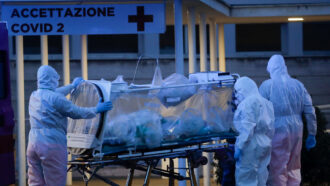
The sickest of COVID-19 patients struggle to breathe. Facing a disease new to science, they’re isolated from their loved ones and treated by doctors and nurses in hazmat suits. Now, a small study in Italy finds that nearly a third of people who were very ill with COVID-19 developed post-traumatic stress disorder after acute infection.
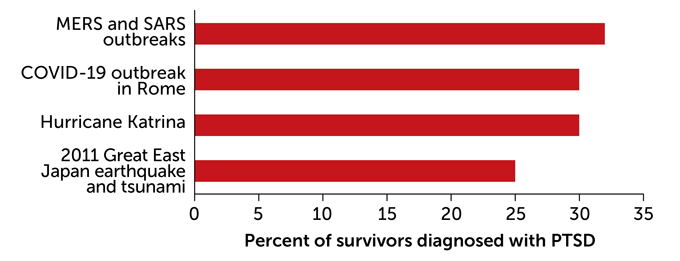
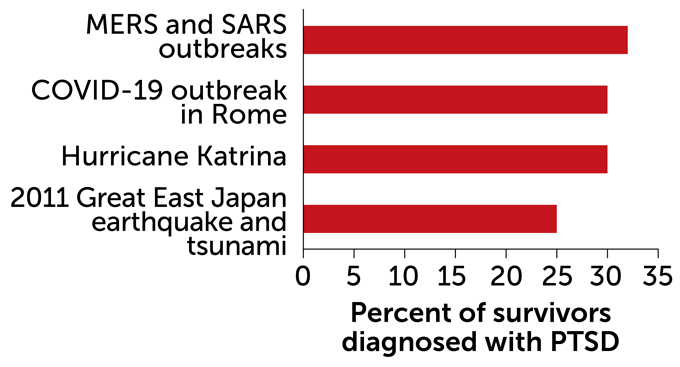
Psychiatrist Delfina Janiri of Agostino Gemelli University Policlinic in Rome and colleagues assessed the mental health of 381 severely ill COVID-19 patients an average of 100 days after symptoms first appeared. About 30 percent, or 115 people, were diagnosed with PTSD, the team reports February 18 in JAMA Psychiatry. Depression and anxiety also turned up in these patients, though not as frequently. PTSD was more common among women, people who had a history of psychiatric disorders, and people who experienced delirium or agitation while very sick with COVID-19.
The rate of PTSD is comparable to that of survivors of other coronavirus infections such as Middle East respiratory syndrome (MERS) and severe acute respiratory syndrome (SARS), as well as natural disasters, the researchers say. About 30 percent of New Orleans residents who survived Hurricane Katrina in 2005 and its aftermath developed PTSD.
Lingering effect
In a small study in Rome, about 30 percent of patients who had recovered from severe COVID-19 went on to develop PTSD. The rate is comparable to that of survivors of the coronavirus infections MERS and SARS, as well as survivors of Hurricane Katrina in 2005 and the Great East Japan earthquake and tsunami in 2011.
Rates of PTSD among survivors of COVID-19 and other traumatic events
 Was the ‘American cheetah’ a cheetah at all?
  AI agents aren’t ready to replace humans in behavioral research
  A culprit for corrosion may have been operating under our noses
 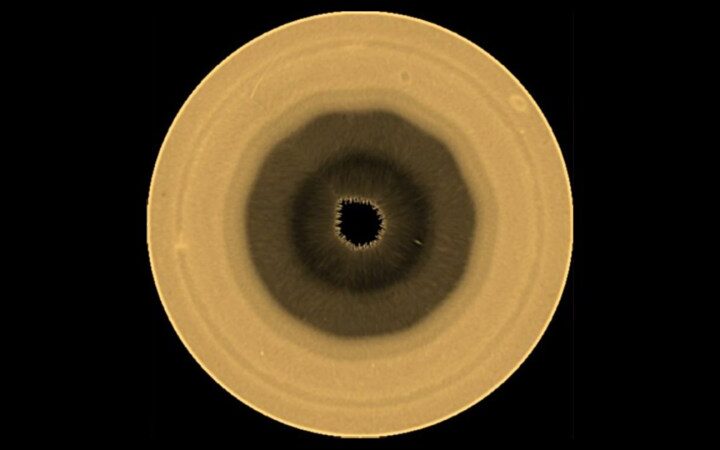 New Hubble images reveal a bizarre decagon over Saturn’s south pole
  A massive study unveils the genetic underpinnings of fibromyalgia
  The universe may have been building rocky planets almost from the start
  Coordinated action on clean air and climate change can net $15 for every dollar spent
  Human rights chief Türk renews call for end to spiralling Sudan war
  AI: Türk urges action before it becomes an ‘existential risk to humanity’
  UNGA 81: A United Nations at a Turning Point