
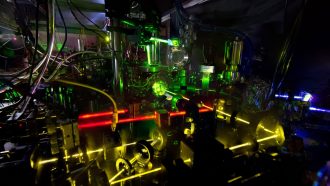
A new measurement moves scientists closer to revamping how we keep time.
After scientists redefined the unit of mass, the kilogram, in 2019, they set their sights on overhauling the fundamental unit of time, the second (SN: 5/20/19). Now, comparisons between three atomic clocks mark an important step toward that goal.
Since the 1960s, the second has been defined by atomic clocks made of cesium atoms, which absorb and emit light at a particular frequency that determines the length of a second. But “there have been a lot of improvements in atomic clocks since then,” says physicist David Hume of the National Institute of Standards and Technology in Boulder, Colo. Improved timepieces called optical atomic clocks (SN: 2/21/14) could be used to more precisely define the second.
But first, scientists must ensure they fully understand the new clocks, for example by comparing the frequencies of light from different timepieces. Now, scientists with the Boulder Atomic Clock Optical Network, or BACON, have made such comparisons, measuring the ratios of frequencies of three atomic clocks, one made of ytterbium atoms, one of strontium atoms and one made with a single electrically charged aluminum atom (SN: 10/5/17). The results are the most precise clock comparisons yet, with uncertainties less than a quadrillionth of a percent, the researchers report in the March 25 Nature.
Because the three clocks were in different locations — two at NIST and the other 1.5 kilometers away at the research institute JILA — the team compared the clocks by sending information across an optical fiber and through an open-air link. This ability to compare distant optical atomic clocks is a step toward clock networks that could be used to make precise measurements such as characterizing Earth’s gravity and testing fundamental physics.
 Magnetism may have helped kick-start our solar system
  Peru’s penguins are on the brink. A super El Niño could make it worse.
  These are the first feathers ever found in fossilized dinosaur poop
  See the secret to DNA hookups
  Meet the newest living cat species, the first described in 100 years
  This year’s El Niño just broke a record months before it’s expected to peak
  LIVE: World leaders take stock of global fight against racism
  Security Council LIVE: Ambassadors meet as West Bank tensions rise, Gaza plan stalls
  DR Congo Ebola emergency: Calls grow for urgent humanitarian access
  Rohingya Camps: Children in Frontline of Food Rationing Crisis