
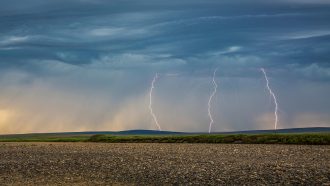
Climate change may be sparking more lightning in the Arctic.
Data from a worldwide network of lightning sensors suggest that the frequency of lightning strikes in the region has shot up over the last decade, researchers report online March 22 in Geophysical Research Letters. That may be because the Arctic, historically too cold to fuel many thunderstorms, is heating up twice as fast as the rest of the world (SN: 8/2/19).
The new analysis used observations from the World Wide Lightning Location Network, which has sensors across the globe that detect radio waves emitted by lightning bolts. Researchers tallied lightning strikes in the Arctic during the stormiest months of June, July and August from 2010 to 2020. The team counted everywhere above 65° N latitude, which cuts through the middle of Alaska, as the Arctic.
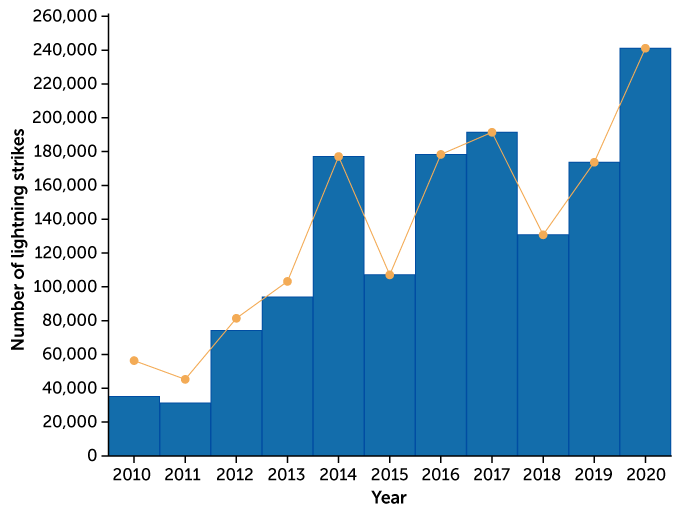
The number of lightning strikes that the detection network precisely located in the Arctic spiked from about 35,000 in 2010 to about 240,000 in 2020. Part of that uptick in detections may have resulted from the sensor network expanding from about 40 stations to more than 60 stations over the decade.
And just looking at the 2010 and 2020 values alone may overstate the increase in lightning, because “there’s such variability, year to year,” and 2020 was a particularly stormy year, says Robert Holzworth, an atmospheric and space scientist at the University of Washington in Seattle. In estimating the increase in average annual lightning strikes, “I would argue that we have really good evidence that the number of strokes in the Arctic has increased by, say, 300 percent,” Holzworth says.
That increase happened while global summertime temperatures rose from about 0.7 degrees Celsius above the 20th century average to about 0.9 degrees C above — hinting that global warming may create more favorable conditions for lightning in the Arctic.
It makes sense that a warmer climate could generate more lightning in historically colder climes, says Sander Veraverbeke, an earth systems scientist at VU University Amsterdam who was not involved in the work. If it does, that could potentially ignite more wildfires (SN: 4/11/19). But the apparent trend in Arctic lightning strikes should be taken with a grain of salt because it covers such a short period of time and the detection network includes few observing stations at high latitudes, Veraverbeke says. “We need more stations in the high north to really accurately monitor the lightning there.”
Zap stats
The frequency of summertime Arctic lightning strikes skyrocketed from 2010 to 2020 (blue bars), according to data collected by the World Wide Lightning Location Network, or WWLLN. Since that uptick may in part be due to the network adding more sensors, researchers calculated the number of lightning strikes they would have expected to see each year if the WWLLN used the same number of sensors over time (orange line). That analysis still showed a major increase in lightning strikes over the decade.
Lightning strikes in the Arctic by year, 2010–2020
 Horned dinosaurs’ weapons evolved to handle the forces of combat
  Artemis II results show how much science people can do at the moon
  Crossword: Time lines
  Many American diets may not include enough of this essential nutrient
  A telling hole in a Neandertal bone hints at a bitter end
  Brain implants are helping people who’ve lost their voice
  COP17: The world has a plan to save nature. Is it working?
  Flour sacks turned flood barriers: Gaza faces another winter without safe shelter
  WHO scales up Ebola readiness in 22 countries across three continents
  Ukraine: Civilian casualty rates among ‘deadliest’ in years, as energy attacks intensify