
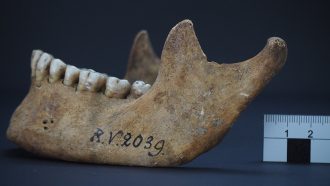
The oldest known strain of the plague-causing bacteria Yersinia pestis has been found lurking in the bones and teeth of a man buried thousands of years ago in what is now Latvia.
Genetic analysis suggests the Y. pestis strain that infected the man emerged around 7,100 years ago, researchers report online June 29 in Cell Reports. It usurps the previous record-holder, found in a 5,000-year-old Scandinavian mass grave associated with a possible plague epidemic (SN: 12/6/18). The Latvia man’s bones are also about 5,000 years old, but DNA comparison suggests he contracted a less virulent strain that emerged 1,000 years earlier in Y. pestis history than that found at the Scandinavian site.
Bacterial DNA also suggest that the ancient plague victim didn’t develop pustules or infect his family. And the strain lacked the gene for swift flea-to-human transmission, which evolved perhaps 3,800 years ago and drove later bubonic plague epidemics, says Ben Krause-Kyora, an archaeologist and biochemist at Kiel University in Germany.
It’s likely this early plague strain passed to humans through isolated encounters, such as from rodent bites, Krause-Kyora and colleagues conclude. The man was carefully buried, and the team didn’t find mass graves or Y. pestis infection in other individuals’ DNA, suggesting people in the area weren’t facing an epidemic (SN: 1/6/21). Without antibiotics, the man probably succumbed to his infection.
Although this Y. pestis is the oldest strain ever found, it ultimately went extinct, being replaced by other, more virulent versions — a common fate in the evolutionary history of both bacteria and viruses. Later Y. pestis strains may have been more contagious, but isolated encounters like this one may help scientists understand the plague’s early history. “Maybe it’s really single events in the beginning, then more and more severe, before it became really dramatic in medieval times,” Krause-Kyora says.
 Was the ‘American cheetah’ a cheetah at all?
  AI agents aren’t ready to replace humans in behavioral research
  A culprit for corrosion may have been operating under our noses
  New Hubble images reveal a bizarre decagon over Saturn’s south pole
  A massive study unveils the genetic underpinnings of fibromyalgia
  The universe may have been building rocky planets almost from the start
  Nuclear Victims’ Experiences Must Be at the Heart of Global Efforts for Assistance and Remediation
  LIECHTENSTEIN: ‘We Have One of the Strictest Abortion Bans in Europe’
  New reservoir offers innovative solution to South Sudan cattle beef
  ‘Advance safety for all’: International police cooperation helps tackle cross-border crime