
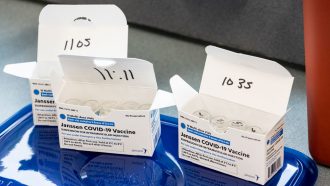
Some COVID-19 vaccines have been linked to dangerous but incredibly rare blood clots. Now a small study is revealing new details on how those clots form.
Vaccine-induced antibodies attach to a protein involved in blood clotting at a similar spot that the anticoagulant drug heparin does, spurring platelets to form clots, researchers report July 7 in Nature.
Researchers already knew that COVID-19 vaccines developed by Johnson & Johnson and AstraZeneca can sometimes cause the body to make antibodies that attach to a protein called platelet factor 4, or PF4, which then causes platelets to form clots (SN: 4/13/21; SN: 4/7/21; SN: 4/16/21). The vaccine-induced condition is similar to what happens with heparin, a blood thinner that can also attach to PF4. When heparin binds to the protein, some people’s immune systems then attack the bound molecules, a counterintuitive condition called heparin-induced thrombocytopenia also characterized by clotting.
Sign up for e-mail updates on the latest coronavirus news and research
Even in light of those similarities, it was still unclear whether antibodies sparked by heparin treatment or COVID-19 vaccines used the same mechanism to prompt platelets to clot.
Angela Huynh, a platelet immunologist at McMaster University in Hamilton, Canada, and colleagues analyzed PF4-recognizing antibodies from 10 heparin-induced thrombocytopenia patients and five patients with COVID-19 vaccine–induced clots, a condition called vaccine-induced immune thrombotic thrombocytopenia, or VITT. The immune proteins from VITT patients attached to a similar spot on PF4 as heparin does, hinting that heparin and COVID-19 vaccines cause blood to clot in similar ways.
PF4-binding antibodies might not be the whole story when it comes to clotting, the researchers say. Knowing how the clots form could help in treating them.
Public health officials continue to say that the vaccines’ benefits against COVID-19 far outweigh the risks of the rare clotting condition (SN: 4/23/21).
 Magnetism may have helped kick-start our solar system
  Peru’s penguins are on the brink. A super El Niño could make it worse.
  These are the first feathers ever found in fossilized dinosaur poop
  See the secret to DNA hookups
  Meet the newest living cat species, the first described in 100 years
  This year’s El Niño just broke a record months before it’s expected to peak
  LIVE: World leaders take stock of global fight against racism
  Security Council LIVE: Ambassadors meet as West Bank tensions rise, Gaza plan stalls
  DR Congo Ebola emergency: Calls grow for urgent humanitarian access
  Rohingya Camps: Children in Frontline of Food Rationing Crisis