
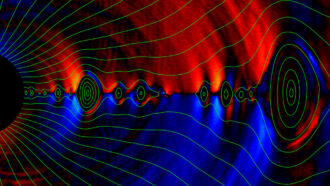
Like a shaggy dog in springtime, some black holes have to shed. New computer simulations reveal how black holes might discard their magnetic fields.
Unlike dogs with their varied fur coats, isolated black holes are mostly identical. They are characterized by only their mass, spin and electric charge. According to a rule known as the no-hair theorem, any other distinguishing characteristics, or “hair,” are quickly cast off. That includes magnetic fields.
The rule applies to black holes in a vacuum, where magnetic fields can simply slip away. But, says astrophysicist Ashley Bransgrove of Columbia University, “what we were thinking about is what happens in a more realistic scenario.” A magnetized black hole would typically be surrounded by electrically charged matter called plasma, and scientists didn’t know how — or even if — such black holes would undergo hair loss.
Black holes can be born with magnetic fields or gain them later, for example by swallowing a neutron star, a highly magnetic dead star (SN: 6/29/21). When Bransgrove and colleagues simulated the plasma surrounding a magnetized black hole, they found that a process called magnetic reconnection allows the magnetic field to escape the black hole. The magnetic field lines that map out the field’s direction break apart and reconnect. Loops of magnetic field form around blobs of plasma, some of which blast outward, while others fall into the black hole. That process eliminates the black hole’s magnetic field, the researchers report in the July 30 Physical Review Letters.
Magnetic reconnection in balding black holes could spew X-rays that astronomers could detect. So scientists may one day glimpse a black hole losing its hair.
 Was the ‘American cheetah’ a cheetah at all?
  AI agents aren’t ready to replace humans in behavioral research
  A culprit for corrosion may have been operating under our noses
  New Hubble images reveal a bizarre decagon over Saturn’s south pole
  A massive study unveils the genetic underpinnings of fibromyalgia
  The universe may have been building rocky planets almost from the start
  Nuclear Victims’ Experiences Must Be at the Heart of Global Efforts for Assistance and Remediation
  LIECHTENSTEIN: ‘We Have One of the Strictest Abortion Bans in Europe’
  New reservoir offers innovative solution to South Sudan cattle beef
  ‘Advance safety for all’: International police cooperation helps tackle cross-border crime