
How the Mountains Grew
John Dvorak
Pegasus Books, $29.95
Imagine a world where pigeon-sized dragonflies soar above spiders with half-meter-long legs, where 2-meter-long millipedes slither and 20-kilogram scorpions hunt. About 300 million years ago, such surreal creatures thrived; today, rocks hint at how these and other creatures in the deep past lived. These clues allow geologist and writer John Dvorak to vividly re-create ancient landscapes in How the Mountains Grew: A New Geological History of North America.
Far from a dusty tome plodding through plate tectonics, the book teems with life as Dvorak establishes inextricable links between geology and biology. Take the oversize dragonflies and millipedes now preserved as fossils. Rocks of a similar age hold evidence of a rise in atmospheric oxygen that helps explain how these animals grew so large.
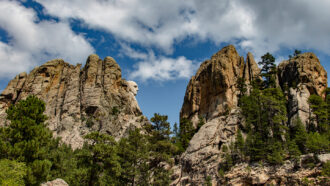
The book zigzags from place to place on a chronological, continental-scale field trip. To avoid dizzying readers, Dvorak revisits certain sites that preserve multiple threads of geologic history. For instance, at Mount Rushmore in South Dakota’s Black Hills, he describes how, about 2 billion years ago, molten rock rose and lodged itself into sedimentary rocks deposited on the seafloor of bygone oceans. Today, presidents’ faces stare out from this now-solidified magma, those ancient oceanic sediments sitting just below the visage of George Washington. The book later returns to glimpse younger seas that came and went, depositing sediments now replete with fossils. All these rocks, Dvorak explains, whisper stories of how this particular mountain grew.
Dvorak also ponders Earth’s future, envisioning an ice sheet grinding down Mount Rushmore’s carefully carved profiles more than 100,000 years from now. And he considers humankind’s future, arguing that we must determine how our dependence on fossil fuels — the result of another interplay between biology and geology — will end.
But it’s a different end, the asteroid impact that marked the demise of the nonbird dinosaurs (SN: 6/1/20), where Dvorak’s storytelling shines brightest. He imagines the final days of the last Tyrannosaurus rex, describing its desperate search for food somewhere well north of Mount Rushmore. In the hours to months after the impact, we share this behemoth’s last steps, its final gasps.
“No degree of evolutionary perfection could have guaranteed survival,” Dvorak writes. As that lone T. rex dies on the page, we can’t help but realize that we, too, are brief biological moments in geologic time.
Buy How the Mountains Grew from Bookshop.org. Science News is a Bookshop.org affiliate and will earn a commission on purchases made from links in this article.
 Was the ‘American cheetah’ a cheetah at all?
  AI agents aren’t ready to replace humans in behavioral research
  A culprit for corrosion may have been operating under our noses
  New Hubble images reveal a bizarre decagon over Saturn’s south pole
  A massive study unveils the genetic underpinnings of fibromyalgia
  The universe may have been building rocky planets almost from the start
  Nuclear Victims’ Experiences Must Be at the Heart of Global Efforts for Assistance and Remediation
  LIECHTENSTEIN: ‘We Have One of the Strictest Abortion Bans in Europe’
  New reservoir offers innovative solution to South Sudan cattle beef
  ‘Advance safety for all’: International police cooperation helps tackle cross-border crime