
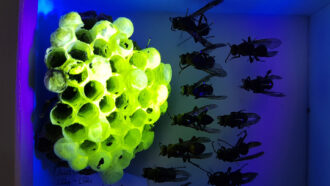
Beam a black light into some Vietnamese forests at night, and brilliant green bulbs may glow in the trees. These eerie lanterns are the nests of several species of Asian paper wasps, and the gleam comes from silk fibers in the nests that fluoresce when struck by ultraviolet light, researchers report in the August Journal of the Royal Society Interface.
“When you see it, it’s just magic,” says chemist Bernd Schöllhorn of the Molecular Electrochemistry Lab at the University of Paris and CNRS.
Schöllhorn and colleagues discovered the nests while searching forests in Vietnam for fluorescent insects using powerful UV torches. “It looked like somebody turned on a flashlight in the forest, but nobody was there,” he says.
A paper wasp nest fluoresces in a northern Vietnamese forest at night.Bernd Schöllhorn, Serge Berthier
Fluorescence occurs throughout the animal kingdom. Platypuses, scorpions and polka dot tree frogs, for example, all fluoresce under UV light (SN: 11/6/20; SN: 4/3/17). After analyzing the fluorescence of the nests of some Asian paper wasps (Polistes spp.) in the lab, the researchers found that silk threads in the nests glow more brilliantly than other documented fluorescent biomaterials.
The nests of one wasp species, P. brunetus, emitted about one-third as much light as they absorbed. And in some cases, the nests were visible by the naked eye from up to 20 meters away. “We haven’t seen any other example like that,” Schöllhorn says. The fluorescence must benefit the wasps somehow, the researchers say, though it’s unclear how. One hypothesis is that the nests protect larvae inside from UV radiation by absorbing some of the harmful energy and dissipating it as visible light, Schöllhorn says (SN: 10/13/20). Or, as the sun casts its last UV light at the end of the day, the nests might shine bright enough amid the darkening foliage to help wayward wasps find home, like beacons at twilight.
 These are the first feathers ever found in fossilized dinosaur poop
  See the secret to DNA hookups
  Meet the newest living cat species, the first described in 100 years
  This year’s El Niño just broke a record months before it’s expected to peak
  Finally, a true blue rose exists
  First series of adult T. rex footprints hints at its walking speed
  The Takeaway: UN General Assembly debate Day 5
  Lavrov issues call for new Eurasian ‘security architecture’
  Cuba warns against ‘law of the jungle’ as Foreign Minister denounces US pressure
  Saudi Arabia warns Gulf security inseparable from global stability amid regional tensions