
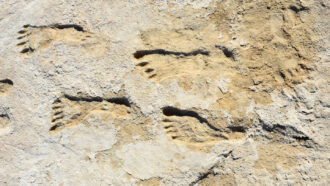
Footprints left behind by prehistoric people may be some of the strongest evidence yet that humans arrived in the Americas earlier than previously thought.
Over 60 “ghost tracks” — so-called because they pop up and disappear across the landscape — show that people romped through what’s now New Mexico 23,000 to 21,000 years ago, geoscientist Matthew Bennett and colleagues report in the Sept. 24 Science. If true, the fossil findings would be definitive proof that humans were in North America during the height of the last ice age, which peaked around 21,500 years ago.
When people first arrived in the Americas is highly contested. Scientists have historically thought that humans traveled across the Bering land bridge that connected Asia to North America around 13,000 years ago, after the massive Laurentide Ice Sheet that once blanketed much of North America had started retreating into the Arctic (SN: 6/26/18). But a slew of more recent discoveries from across North and South America — including roughly 30,000-year-old animal bones from a Mexican cave (SN: 6/9/21) and stone tools from Texas (SN: 7/11/18) — suggest that humans may have arrived far earlier.
At White Sands National Park in New Mexico, Bennett, of Bournemouth University in Poole, England, and colleagues used several methods to calculate the ages of the newly described tracks, including radiocarbon dating of aquatic plants embedded in and between the footprints.
“One of the beautiful things about footprints is that, unlike stone tools or bones, they can’t be moved up or down the stratigraphy,” he says. “They’re fixed, and they’re very precise.”
But some archaeologists aren’t yet convinced of the footprints’ ages. Loren Davis, an anthropologist at Oregon State University in Corvallis, says that he would like to see the researchers use other validation techniques to check the dates before “breaking out the champagne.”
“This is the kind of stuff that makes you rewrite textbooks,” Davis says. “For the good of the field, we need really high standards.” But if further verification confirms the age of the tracks, he says the discovery will “show us that people have this amazing ability to survive and thrive during a time when global conditions were extreme.”
The tracks were created over two millennia mostly by children and teenagers wandering through the patchwork of waterways that defined the White Sands area during the Ice Age, the researchers say. The footprints were found alongside those of mammoths, giant ground sloths and other megafauna that flocked to water in the largely arid landscape.
Bennett is planning on returning to White Sands after the pandemic to continue studying human footprints, hoping to learn more about the people who made them. “Footprints have a way of connecting you to the past that’s like nothing else,” he says. “It’s very powerful to put your finger in the base of a track and know that someone walked that way 23,000 years ago.”
 Light is hard to block from every direction. This physicist found a way
 Science to restore speech is moving fast. Here’s what’s next
 Toxic secrets are hiding in Arctic ice
 Fossil fuel emissions are down in 2026. Green energy isn’t the reason
 Drugs like Ozempic may help reverse chronic kidney disease
 A high-fiber diet may clear away plastic in the gut
 Egypt: Fact-checking site’s entire newsroom jailed as assault on press freedom widens
 Nearly 64,000 flee Nigeria for Niger where a humanitarian crisis is deepening
 Ebola: IOM urges wider surveillance beyond formal routes in DR Congo