
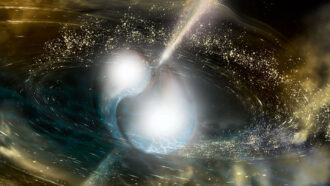
The cosmic origins of elements heavier than iron are mysterious. One elemental birthplace came to light in 2017 when two neutron-rich dead stars collided and spewed out gold, platinum and other hefty elements (SN: 10/16/17). A few years later, a smashup of another neutron star and a black hole left scientists wondering which type of cosmic clash was the more prolific element foundry (SN: 6/29/21).
Now, they have an answer. Collisions of two neutron stars probably take the cake, scientists report October 25 in Astrophysical Journal Letters.
To create heavy elements after either type of collision, neutron star material must be flung into space, where a series of nuclear reactions called the r-process can transform the material (SN: 4/22/16).
How much material escapes into space, if any, depends on various factors. For example, in collisions of a neutron star and black hole, the black hole has to be relatively small, or “there’s no hope at all,” says astrophysicist Hsin-Yu Chen of MIT. “It’s going to swallow the neutron star right away,” without ejecting anything.
Questions remain about both types of collisions, spotted via the ripples in spacetime that they kick up. So Chen and colleagues considered a range of possibilities for the properties of neutron stars and black holes, such as the distributions of their masses and how fast they spin. The team then calculated the mass ejected by each type of collision under those varied conditions. In most scenarios, the neutron star–black hole mergers made a smaller quantity of heavy elements than the neutron star duos — in one case only about a hundredth the amount.
Still, the ultimate element factory ranking remains up in the air. The scientists compared just these two types of collisions, not other possible sources of heavy elements such as exploding stars (SN: 7/7/21).
 Was the ‘American cheetah’ a cheetah at all?
  AI agents aren’t ready to replace humans in behavioral research
  A culprit for corrosion may have been operating under our noses
  New Hubble images reveal a bizarre decagon over Saturn’s south pole
  A massive study unveils the genetic underpinnings of fibromyalgia
  The universe may have been building rocky planets almost from the start
  New reservoir offers innovative solution to South Sudan cattle beef
  ‘Advance safety for all’: International police cooperation helps tackle cross-border crime
  Midwives: The Workforce That Will Determine Maternal and Newborn Survival and Africa’s Future
  Bridging Digital Transformation in an ASEAN-EAEU Cooperation