
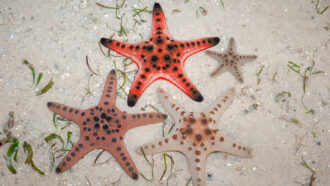
Some starfish made of a brittle material fortify themselves with architectural antics.
Beneath a starfish’s skin lies a skeleton made of pebbly growths, called ossicles, which mostly consist of the mineral calcite. Calcite is usually fragile, and even more so when it is porous. But the hole-riddled ossicles of the knobby starfish (Protoreaster nodosus) are strengthened through an unexpected internal arrangement, researchers report in the Feb. 11 Science.
“When we first saw the structure, we were really amazed,” says Ling Li, a materials scientist at Virginia Tech in Blacksburg. It looks like it’s been 3-D printed, he says.
Li and colleagues used an electron microscope to zoom in on ossicles from several dozen dead knobby starfish. At a scale of 50 micrometers, about half the width of a human hair, the seemingly featureless body of each ossicle gives way to a meshlike pattern that mirrors how carbon atoms are arranged in a diamond.
Zooming in on the bumpy growths called ossicles (seen in this electron microscope image) that make up a knobby starfish’s skeleton reveals a meshlike structure similar to the arrangement of carbon atoms in diamond. This arrangement strengthens the ossicles, which are mostly made of calcite, a relatively weak mineral.Ling Li/Virginia Tech
But the diamondlike lattice alone doesn’t fully explain how the ossicles stay strong.
Within that lattice, the atoms that make up the calcite have their own pattern, which resembles a series of stacked hexagons. That pattern affects the strength of the calcite too. In general, a mineral’s strength isn’t uniform in all directions. So pushing on calcite in some directions is more likely to break it than force from other directions. In the ossicles, the atomic pattern and the diamondlike lattice align in a way that compensates for calcite’s intrinsic weakness.
It’s a mystery how the animals make the diamondlike lattice. Li’s team is studying live knobby starfish, surveying the chemistry of how ossicles form. Understanding how the starfish build their ossicles may provide insights for creating stronger porous materials, including some ceramics.
We can learn a lot from a creature like a starfish that we may think is primitive, Li says.
 Magnetism may have helped kick-start our solar system
  Peru’s penguins are on the brink. A super El Niño could make it worse.
  These are the first feathers ever found in fossilized dinosaur poop
  See the secret to DNA hookups
  Meet the newest living cat species, the first described in 100 years
  This year’s El Niño just broke a record months before it’s expected to peak
  The Takeaway Day 6: General Debate ends with a plea to turn words into action
  Overshoot of Paris Agreement and the Looming Super El Niño Drive Urgent Calls for Global Climate Action at UNGA 81
  World News in Brief: Refugee funding, US migration policy triggers ‘cascade’ of rights violations, world forests report, restorative justice in Colombia
  From energy crisis to energy transition: How renewables are reshaping energy security