
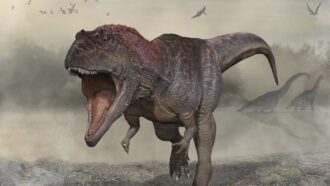
Tyrannosaurus rex’s tiny arms have launched a thousand sarcastic memes: I love you this much; can you pass the salt?; row, row, row your … oh.
But back off, snarky jokesters. A newfound species of big-headed carnivorous dinosaur with tiny forelimbs suggests those arms weren’t just an evolutionary punchline. Arm reduction — alongside giant heads — evolved independently in different dinosaur lineages, researchers report July 7 in Current Biology.
Meraxes gigas, named for a dragon in George R. R. Martin’s “A Song of Ice and Fire” book series, lived between 100 million and 90 million years ago in what’s now Argentina, says Juan Canale, a paleontologist with the country’s CONICET research network who is based in Buenos Aires. Despite the resemblance to T. rex, M. gigas wasn’t a tyrannosaur; it was a carcharodontosaur — a member of a distantly related, lesser-known group of predatory theropod dinosaurs. M. gigas went extinct nearly 20 million years before T. rex walked on Earth.
The M. gigas individual described by Canale and colleagues was about 45 years old and weighed more than four metric tons when it died, they estimate. The fossilized specimen is about 11 meters long, and its skull is heavily ornamented with crests and bumps and tiny hornlets, ornamentations that probably helped attract mates.
Why these dinosaurs had such tiny arms is an enduring mystery. They weren’t for hunting: Both T. rex and M. gigas used their massive heads to hunt prey (SN: 10/22/18). The arms may have shrunk so they were out of the way during the frenzy of group feeding on carcasses.
But, Canale says, M. gigas’ arms were surprisingly muscular, suggesting they were more than just an inconvenient limb. One possibility is that the arms helped lift the animal from a reclining to a standing position. Another is that they aided in mating — perhaps showing a mate some love.
 Horned dinosaurs’ weapons evolved to handle the forces of combat
  Artemis II results show how much science people can do at the moon
  Crossword: Time lines
  Many American diets may not include enough of this essential nutrient
  A telling hole in a Neandertal bone hints at a bitter end
  Brain implants are helping people who’ve lost their voice
  WHO scales up Ebola readiness in 22 countries across three continents
  Ukraine: Civilian casualty rates among ‘deadliest’ in years, as energy attacks intensify
  As disasters mount, next UN climate summit faces a test of trust
  Gaza: 340 children killed despite ceasefire agreement – UNICEF