
Even teeny objects obey the law of gravity.
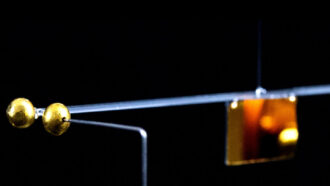
A gold ball just 2 millimeters wide, with a mass of about 90 milligrams, is now the smallest object to have its gravitational pull measured. Observations of that gold sphere tugging on another similarly sized sphere confirm that gravity behaves as expected even for extremely weak gravitational fields, physicists report in the March 11 Nature. Previous experiments have involved objects with masses of hundreds of milligrams or more.
Newton’s law of universal gravitation states that the gravitational force between two masses is inversely proportional to the square of the distance between them. Double the distance between two objects and they’ll pull on one another with one quarter the strength.
A team of physicists based in Vienna tested whether that relationship holds up for tiny masses. The researchers attached a gold sphere to a horizontally suspended beam that was free to rotate in response to the gravitational pull of another gold sphere just a few millimeters away. The experimenters measured the motions of the first sphere while repeatedly moving the second sphere closer and farther away. The results matched predictions of Newton’s law and of Einstein’s general theory of relativity, two theories of gravity that are equivalent under most everyday conditions (SN: 10/4/15).
Ultimately, researchers want to test how gravity behaves on far smaller scales (SN: 10/28/20) — for objects so minuscule that they can perform quantum feats, such as existing in multiple places at once. The gold spheres are too large to follow quantum rules, but the experiment takes scientists a small step closer to exploring gravity’s quantum side.
 Magnetism may have helped kick-start our solar system
  Peru’s penguins are on the brink. A super El Niño could make it worse.
 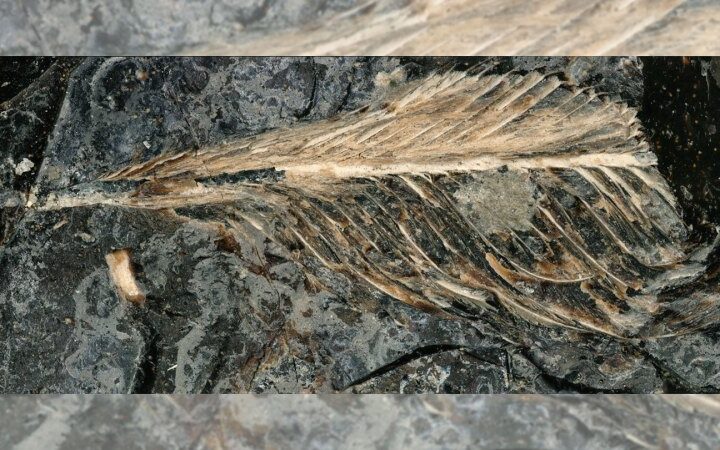 These are the first feathers ever found in fossilized dinosaur poop
 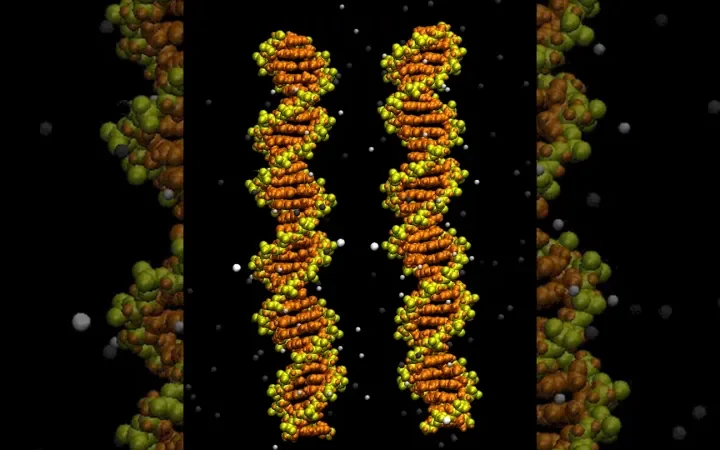 See the secret to DNA hookups
  Meet the newest living cat species, the first described in 100 years
 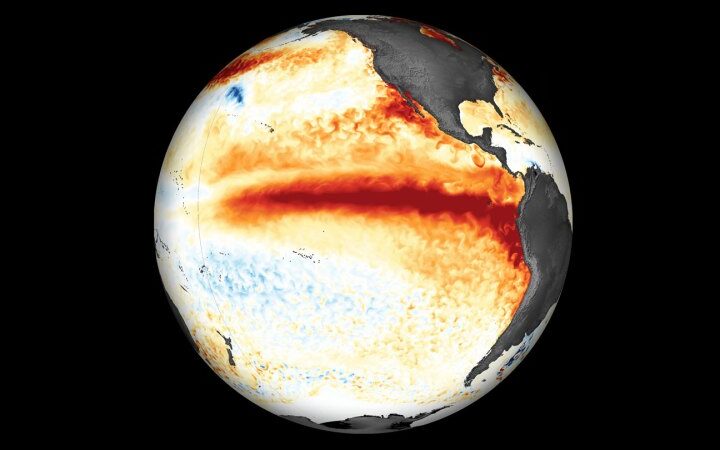 This year’s El Niño just broke a record months before it’s expected to peak
  LIVE: World leaders take stock of global fight against racism
  Security Council LIVE: Ambassadors meet as West Bank tensions rise, Gaza plan stalls
  DR Congo Ebola emergency: Calls grow for urgent humanitarian access
  Rohingya Camps: Children in Frontline of Food Rationing Crisis