
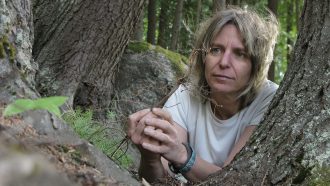
Finding the Mother Tree
Suzanne Simard
Knopf, $28.95
Opening Suzanne Simard’s new book, Finding the Mother Tree, I expected to learn about the old growth forests of the Pacific Northwest. I had an inkling that Simard, a forest ecologist at the University of British Columbia in Vancouver, would walk through her painstaking research to convince logging companies and others that clear-cutting large parcels of land is too damaging for forests to recover. I didn’t expect to be carried along on her very relatable journey through life.
Simard was born in the Monashee Mountains of British Columbia in 1960. Her family of loggers selectively cut trees and dragged them out with horses, leaving plenty still standing. In her first stab at a career, she joined a commercial logging company that clear-cut with large machinery. Her job was to check on seedlings the firm had planted in those areas to restart the forest. The fledgling plants were often yellowed and failing. Simard’s instincts told her those trees were missing the resources that exist within a diverse community of plants, so she set out to see if her hunch was right.
She learned how to do experiments, with close calls with grizzly bears and other mishaps along the way, eventually becoming a tenured professor. She and colleagues discovered that underground networks of fungi among tree roots shuttle carbon and nutrients from tree to tree (SN: 8/9/97, p. 87). Simard seamlessly weaves details of her studies of these networks with her life’s travails: sibling relationships and loss, struggles as a woman in a male-dominated field and her own recovery from a health crisis. Like many women who work outside the home, she felt torn between being with her young daughters and pursuing her professional passions.
Readers will feel for Simard as much as they worry for the forests that are quickly disappearing. Simard presents plenty of evidence and writes enthusiastically to build her analogy of the “mother trees” — the biggest, oldest trees in a forest that nurture those nearby. In her experiments, seedlings planted near a mother tree were much more likely to survive.
“Trees and plants have agency,” she writes. “They cooperate, make decisions, learn and remember — qualities we normally ascribe to sentience, wisdom, intelligence.” Simard encourages logging companies to save the mother trees when harvesting to maintain the networks of information — the internet of the forest. Industry change has been slow, but she’s optimistic: “Sometimes when it seems nothing will budge, there’s a shift.”
Buy Finding the Mother Tree from Bookshop.org. Science News is a Bookshop.org affiliate and will earn a commission on purchases made from links in this article.
 Magnetism may have helped kick-start our solar system
  Peru’s penguins are on the brink. A super El Niño could make it worse.
  These are the first feathers ever found in fossilized dinosaur poop
  See the secret to DNA hookups
  Meet the newest living cat species, the first described in 100 years
  This year’s El Niño just broke a record months before it’s expected to peak
  LIVE: World leaders take stock of global fight against racism
  Security Council LIVE: Ambassadors meet as West Bank tensions rise, Gaza plan stalls
  DR Congo Ebola emergency: Calls grow for urgent humanitarian access
  Rohingya Camps: Children in Frontline of Food Rationing Crisis