
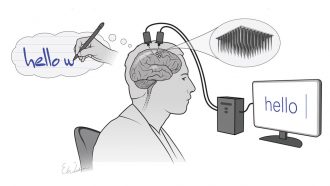
Electrodes in a paralyzed man’s brain turned his imagined handwriting into words typed on a screen. The translation from brain to text may ultimately point to ways to help people with disabilities like paralysis communicate using just their thoughts.
A 65-year-old man had two grids of tiny electrodes implanted on the surface of his brain. The electrodes read electrical activity in the part of the brain that controls hand and finger movements. Although the man was paralyzed from the neck down, he imagined writing letters softly with his hand. With an algorithm, researchers then figured out the neural patterns that went with each imagined letter and transformed those patterns into text on a screen.
From his brain activity alone, the participant produced 90 characters, or 15 words, per minute, Krishna Shenoy, a Howard Hughes Medical Institute investigator at Stanford University, and colleagues report May 12 in Nature. That’s about as fast as the average typing rate of people around the participant’s age on smartphones.
The thought-to-text system worked even long after the injury. “The big surprise is that even years and years after spinal cord injury, where you haven’t been able to use your hands or fingers, we can still listen in on that electrical activity. It’s still very active,” Shenoy says.
Thought-powered communication is still in its early stages (SN: 4/24/19). Research with more volunteers is needed, but “there’s little doubt that this will work again in other people,” says Shenoy. The researchers plan to test the system with a person who has lost both the ability to move and speak.
 Magnetism may have helped kick-start our solar system
  Peru’s penguins are on the brink. A super El Niño could make it worse.
  These are the first feathers ever found in fossilized dinosaur poop
  See the secret to DNA hookups
  Meet the newest living cat species, the first described in 100 years
  This year’s El Niño just broke a record months before it’s expected to peak
  The Takeaway Day 6: General Debate ends with a plea to turn words into action
  Overshoot of Paris Agreement and the Looming Super El Niño Drive Urgent Calls for Global Climate Action at UNGA 81
  World News in Brief: Refugee funding, US migration policy triggers ‘cascade’ of rights violations, world forests report, restorative justice in Colombia
  From energy crisis to energy transition: How renewables are reshaping energy security