
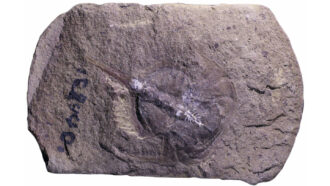
Paleontologists can spend years carefully splitting rocks in search of the perfect fossil. But with a 310-million-year-old horseshoe crab brain, nature did the work, breaking the fossil in just the right way to reveal the ancient arthropod’s central nervous system.
Of all soft tissues, brains are notoriously difficult to preserve in any form (SN: 10/31/16). Stumbling across such a detailed specimen purely by chance was “a one-in-a-million find, if not rarer,” says evolutionary paleontologist Russell Bicknell of the University of New England in Armidale, Australia.
The fossilized brain is remarkably similar to the brains of modern horseshoe crabs, giving clues to the arthropods’ evolution, Bicknell and colleagues report July 26 in Geology. And the brain’s peculiar mode of preservation could point paleontologists toward new places to look for hard-to-find fossils of soft tissues.
Horseshoe crabs have a fossil record spanning roughly 445 million years. But having a long fossil record is one thing. For many animals, including the crabs, fossils of their soft tissues are extremely uncommon because the tissues tend to degrade far quicker than fossilization can occur. Finding the delicate fatty structures that form a brain preserved in rock is especially rare. Only about 20 samples of fossilized arthropod neural tissue have been identified to date.
The newly described brain — part of a larger fossil of the extinct Euproops danae that Bicknell found at the Yale Peabody Museum of Natural History — was originally dug up from the Mazon Creek fossil beds roughly an hour southwest of Chicago. That site is one of the only known places in the world that could have saved thebrain’s structure, says paleontologist Victoria McCoy of the University of Wisconsin–Milwaukee.
“The fossilization at Mazon Creek is really, really exceptional,” McCoy explains. “It’s interesting because the fossils are preserved inside concretions,” which are spherical rocks that form around a central nugget of material, such as a long-dead crab. Most concretions in other fossil beds have no fossils or fossils that are just bones and hard parts, but “Mazon Creek has really good, soft-tissue preservation inside these concretions,” she says.
That’s because the concretions there are partly made of an iron-carbonate mineral called siderite that only forms in low-oxygen environments. That low-oxygen setting almost certainly slowed tissue decay, the scientists say, giving it time to be preserved. In an oxygenated environment, the decay could have happened in weeks, and the brain would have probably wasted away too quickly.
The actual process of preservation was a multistep ordeal, Bicknell says. “First, of course, the horseshoe crab had to die.” As the crab decayed, surrounded by mud and not much oxygen, that siderite coated the crab’s body, allowing it and its fragile brain structure to be preserved. After the brain degraded, the siderite “mold” was filled in with a pale, clay mineral called kaolinite, creating a white brain structure that stands out starkly on the otherwise tan fossil. Over time, a sphere of rock formed around the fossil before eventually breaking open in a fortuitous way.
The brain structure of a modern horseshoe crab (shown in this confocal laser scan image) is strikingly similar to the brain of a recently discovered 310-million-year-old horseshoe crab.R. Bicknell et al/Geology 2021
Based on studies in similar modern environments, such as the North Norfolk marshes in England, the whole preservation process probably took fewer than 50 years, McCoy says. That’s much faster than some other fossilization processes, which can take thousands of years or more. “Neural tissue degrades fairly quickly. We have no reason to think it would be stable,” she says. “While we don’t completely understand how concretions form, all the evidence so far is that it’s the concretion itself that is the preservation force keeping things from decaying away.”
The high preservation quality in these siderite concretions may point paleontologists in new directions for finding soft-tissue fossils. Only several environments capable of producing siderite concretions in the rock record have been identified so far, but the sites could be practical targets for future fossil searches.
“The most important part here is that purely by chance, the fossil was split along its brain,” Bicknell says. The concretion was cracked in just the right orientation to reveal a near-perfect cross section of the brain’s structure. “If it hadn’t broken that way, we wouldn’t have this level of information. It was ultimately quite lucky.”
The preserved central nervous system lends insight into the ancient crab’s behavior, the researchers say. Because the fossil brain is so similar to the brains of modern horseshoe crabs, Bicknell says, it’s safe to say the ancient animal’s walking, breathing and even feeding habits were probably similar to horseshoe crabs’ today, including eating with their legs. “Imagine eating a hamburger with your elbows,” Bicknell says.
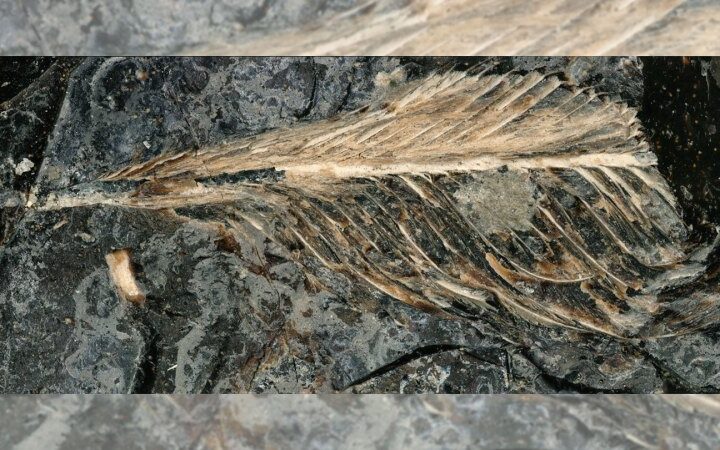 These are the first feathers ever found in fossilized dinosaur poop
 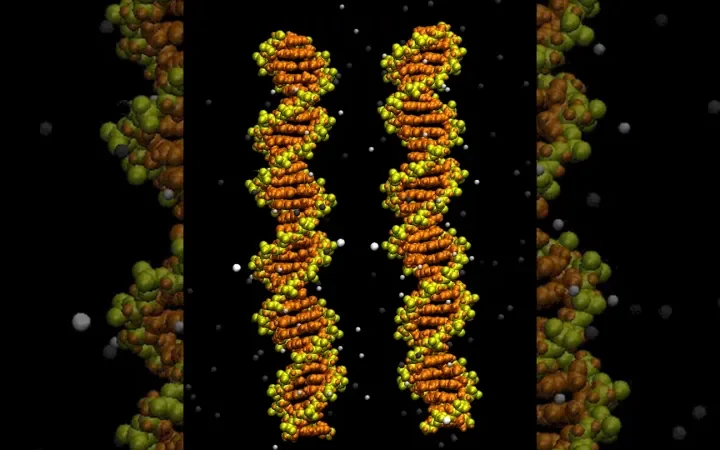 See the secret to DNA hookups
 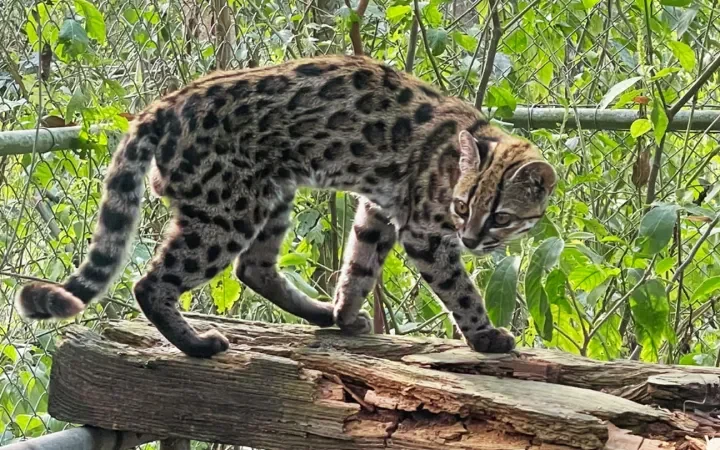 Meet the newest living cat species, the first described in 100 years
  This year’s El Niño just broke a record months before it’s expected to peak
  Finally, a true blue rose exists
 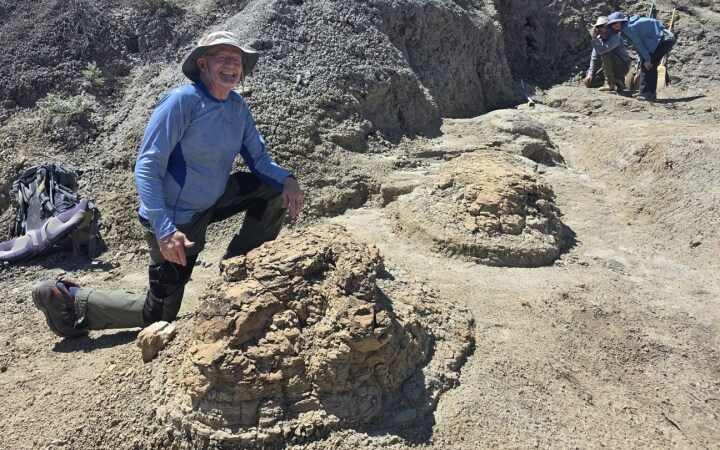 First series of adult T. rex footprints hints at its walking speed
  The Takeaway: UN General Assembly debate Day 5
  Lavrov issues call for new Eurasian ‘security architecture’
  Cuba warns against ‘law of the jungle’ as Foreign Minister denounces US pressure
  Saudi Arabia warns Gulf security inseparable from global stability amid regional tensions