
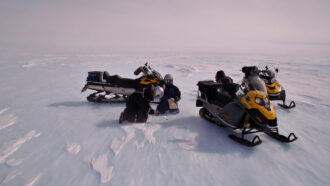
The hunt for meteorites may have just gotten some new leads. A powerful new machine learning algorithm has identified over 600 hot spots in Antarctica where scientists are likely to find a bounty of the fallen alien rocks, researchers report January 26 in Science Advances.
Antarctica isn’t necessarily the No. 1 landing spot for meteorites, bits of extraterrestrial rock that offer a window into the birth and evolution of the solar system. Previous estimates suggest more meteorites probably land closer to the equator (SN: 5/29/20). But the southern continent is still the best place to find them, says Veronica Tollenaar, a glaciologist at the Université libre de Bruxelles in Belgium. Not only are the dark specks at the surface starkly visible against the white background, but quirks of the ice sheet’s flow can also concentrate meteorites in “stranding zones.”
The trouble is that so far, meteorite stranding zones have been found by luck. Satellites help, but poring through the images is time-consuming, and field reconnaissance is costly. So Tollenaar and her colleagues trained computers to find these zones more quickly.
Such stranding zones form when the slow creep of the ice sheet over the land encounters a mountain or hidden rise in the ground. That barrier shifts the flow upward, carrying any embedded space rocks toward the surface.
Combining a machine learning algorithm with data on the ice’s velocity and thickness, surface temperatures, the shape of the bedrock and known stranding zones, Tollenaar and colleagues created a map of 613 probable meteorite hot spots, including some near existing Antarctic research stations.
To date, about 45,000 meteorites have been plucked from the ice. But that’s a fraction of the 300,000 bits of space rock estimated to lie somewhere on the continent’s surface.
The team has yet to test the map on the ground; a COVID-19 outbreak at the Belgian station in December halted plans to try it during the 2021–2022 field season. It will try again next year. Meanwhile, the team is making these data freely accessible to other researchers, hoping they’ll take up the hunt as well.
 Magnetism may have helped kick-start our solar system
  Peru’s penguins are on the brink. A super El Niño could make it worse.
  These are the first feathers ever found in fossilized dinosaur poop
  See the secret to DNA hookups
  Meet the newest living cat species, the first described in 100 years
  This year’s El Niño just broke a record months before it’s expected to peak
  World News in Brief: Refugee funding, US migration policy triggers ‘cascade’ of rights violations, world forests report, restorative justice in Colombia
  From energy crisis to energy transition: How renewables are reshaping energy security
  Sudan tells UN: No imposed solutions to country’s conflict
  ‘Ballot must replace the bullets’, South Sudan tells General Assembly ahead of elections