
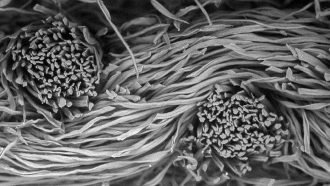
Studying fabrics at very high magnification helps determine how some face masks filter out particles better than others. And the close-ups reveal an unseen beauty of the mundane objects that have now become an essential part of life around the world.
As scientists continue to show how effective masks can be at slowing the spread of the new coronavirus, particularly when they have a good fit and are worn correctly, some have taken microscopic approaches (SN: 2/12/21).
“Embedded in microscale textures are clues as to why materials have various properties,” says Edward Vicenzi, a microanalysis expert at the Smithsonian’s Museum Conservation Institute in Suitland, Md. “Unraveling that evidence turns out to be a fun job.”
Before the pandemic, Vicenzi spent his days observing meteorites, stones and other museum specimens under the microscope. But in March 2020, as the COVID-19 pandemic progressed, he and colleagues from the National Institute for Standards and Technology in Gaithersburg, Md., felt a strong desire to contribute to beating back the virus. So they started studying face-covering materials instead.
-
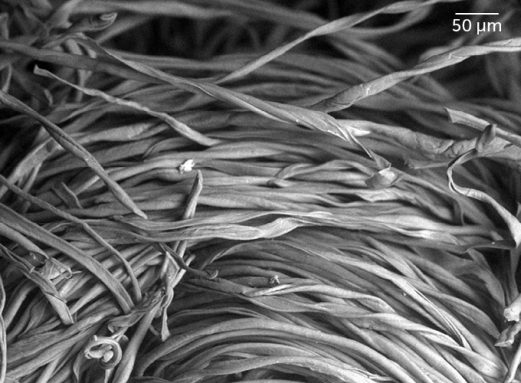
Cotton flannel: A network of cotton fibers “hovers” above a woven surface in this view of the fabric. This chaotic arrangement gives cotton flannel fibers additional opportunities to grab particles as they flow through the fabric. E.P. Vicenzi/Smithsonian’s Museum Conservation Institute and NIST -
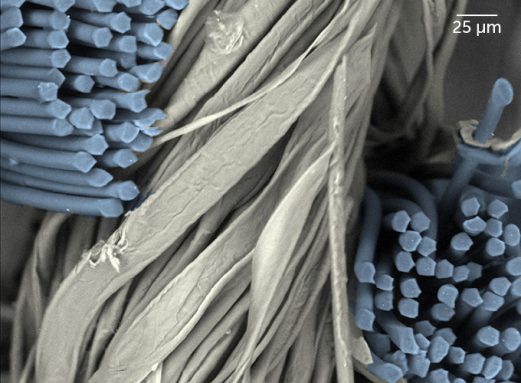
Polyester-cotton blend: Disheveled natural cotton fibers (pale) contrast with nearly identical polyester fibers (blue) in this false-color image. Polyester fibers are highly organized, mostly straight and smooth, making them less effective than cotton fibers alone at trapping nanoscale particles. E.P. Vicenzi/Smithsonian’s Museum Conservation Institute and NIST -
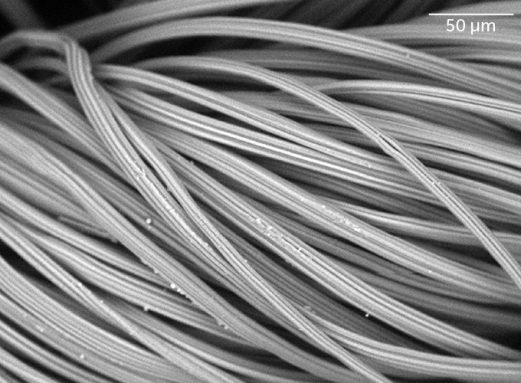
Rayon: Like patterns observed on rigatoni pasta, grooves run along the length of rayon fibers. Unlike cotton flannels, rayon has no apparent weblike structures formed from raised fibers, making it easier for particles to move from one side of the synthetic fabric to the other. E.P. Vicenzi/Smithsonian’s Museum Conservation Institute and NIST -
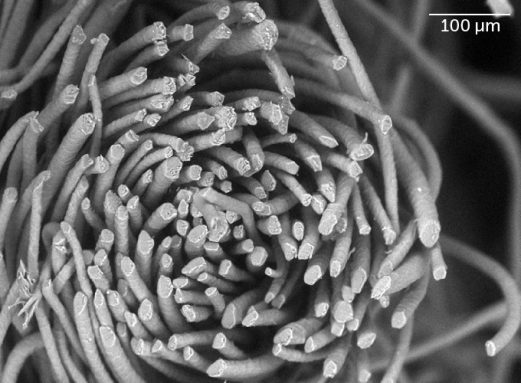
Wool flannel: Seen in cross-section, these fibers resemble a hurricane swirl. Wool flannel can also form fiber webs that block particles, but those webs are not as effective as ones in 100-percent cotton, researchers found. E.P. Vicenzi/Smithsonian’s Museum Conservation Institute and NIST -
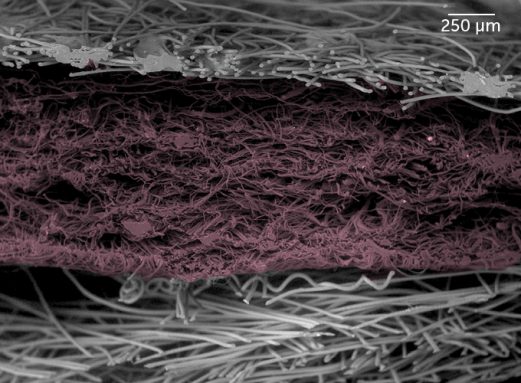
N95 mask: In an N95 mask (seen in false color cross-section), a thin outer layer (top) and thick inner layer (bottom) sandwich a filtration layer (purple), which traps the smallest particles. The multilayered assemblage made of plastic is melted and blown into a weblike fabric, which makes N95s filter particles better than cloth masks, even cotton ones. E.P. Vicenzi/Smithsonian’s Museum Conservation Institute and NIST
Using a scanning electron microscope, Vicenzi and colleagues have examined dozens of materials, including coffee filters, pillowcases, surgical masks and N95 masks. In 2020, the team found that N95 respirator masks are the most effective at providing protection from aerosols like the ones in which SARS-CoV-2, the virus that causes COVID-19, travels. And the researchers reported that synthetic fabrics, like chiffon or rayon, don’t trap as many particles as tightly woven cotton flannels.
Microscopic textures can explain each fabric’s ability to filter out aerosols. The random nature of cotton fibers — with its wrinkled texture and complex shapes such as kinks, bends and folds — probably allows cotton to trap more nanoscale particles than other fabrics, Vicenzi says. In contrast, polyester fabrics have highly organized, mostly straight and smooth fibers, which makes them less efficient as face masks.
Cotton flannels also provide additional protection by absorbing moisture from breath, Vicenzi and colleagues report March 8 in ACS Applied Nano Materials.
“Since cotton loves water, it swells up in humid environments, and that makes it harder for particles to make their way through a mask,” says Vicenzi. Polyester and nylon masks, on the other hand, “repel water from your breath, so there’s no added benefit.”
Through his work, Vicenzi has explored the unseen world of face-covering materials. Some textiles remind him of food, such as rayon’s fibers that resemble the texture of rigatoni pasta. Others, like wool, remind him of atmospheric patterns such as the swirl of a hurricane.
Vicenzi plans to keep observing face masks up close. And he hopes his research helps people decide how to best protect themselves and others during the COVID-19 pandemic. “It’s nice to use an effective material for a mask if you can,” he says. “However, wearing any mask compared to none at all makes the biggest difference in slowing the spread of pathogens.”
 Finally, a true blue rose exists
  First series of adult T. rex footprints hints at its walking speed
  Can AI reason without words? A small model puts the idea to the test
  Meet the ‘fire amoeba,’ a record-breaking survivor of extreme heat
  ‘Happy Snacking, Don’t Die!’ is a joyous guide to eating wild plants
  First radio waves seen from an exoplanet hint at otherworldly auroras
  When a country goes underwater: Island States fight for their future
  Floods, Hunger and Disease Pile on Myanmar’s Civil War Misery
  IRAQ: ‘Art Is the Only Weapon That Doesn’t Hurt or Kill’