


NEW DELHI, India, Feb 19 (IPS) – Subjective wellbeing and income are intricately linkedThe question whether the rich are more satisfied with their lives is often taken for granted, even though surveys, like the Gallup World Poll, show that the relationship between subjective well-being and income is often weak, except in low-income countries in Africa and South Asia. Researcher Daniel Kahneman and his collaborators, for example, report that the correlation between household income and reported life satisfaction or happiness with life typically ranges from 0.15 to 0.30. There are a few plausible reasons. First, growth in income mostly has a transitory effect on individuals’ reported life satisfaction, as they adapt to material goods. Second, relative income, rather than the level of income, affects well-being — earning more or less than others looms larger than how much one earns. Third, though average life satisfaction in countries tends to rise with GDP per capita at low levels of income, there is little increase in life satisfaction once GDP per capita exceeds $10,000 (in purchasing power parity). This article studies the relationships between subjective well-being, which is narrowly defined to focus on economic well-being in India, and variants of income, based on the only panel survey in India Human Development Survey (IHDS).
Read the full story, “Money vs. Happiness”, on globalissues.org →
 Protecting Earth’s fragile biodiversity takes spotlight at Armenia talks
 Gaza: Funding cuts leave half a million without food assistance
 Afro-Brazilian Religious Communities Face Mounting Discrimination Amid the Climate Crisis
 Inside the New York ‘time machine’ racing to save a century of sound and film
 CHINA: ‘My Sister Has Been in a Chinese Prison for Eight Years Because I Exercised My Freedom of Speech’
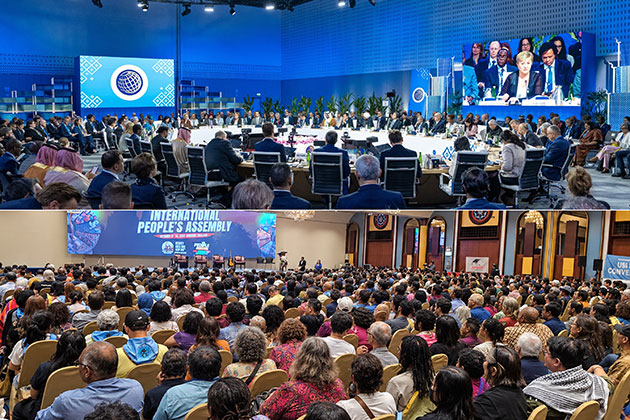 Two Summits in Bangkok: IMF/World Bank and Finance Ministers Inside, the People’s Assembly Outside
 These tiny snakes cartwheel to escape danger