
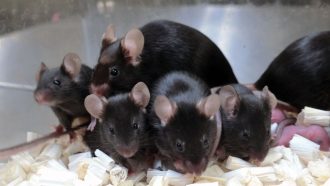
Sperm appears to be unfazed by long stints in outer space.
In the longest biological experiment on the International Space Station yet, freeze-dried mouse sperm remained viable after nearly six years in space. Exposure to space radiation didn’t seem to harm the sperm’s DNA or the cells’ ability to produce healthy “space pups,” researchers report online June 11 in Science Advances.
That may be good news for future spacefarers. Scientists have worried that chronic exposure to space radiation might not only put astronauts at risk for cancer and other diseases, but also create mutations in their DNA that could be passed down to future generations (SN: 9/25/20). The new results hint that deep-space travelers could safely bear children.
Studying how space radiation affects reproduction is tricky. Instruments on Earth can’t perfectly mimic space radiation, and the ISS lacks freezers for long-term cell storage. So biologist Teruhiko Wakayama of the University of Yamanashi in Kōfu, Japan and colleagues freeze-dried sperm, allowing it to be stored at room temperature. The team then sent sperm from 12 mice to the space station, while keeping other sperm from the same mice on the ground.
After returning the sperm cells to Earth, rehydrating them and injecting them into fresh mouse eggs, the team transferred those embryos to female mice. About 240 healthy space pups were born from sperm kept on the ISS for nearly three years; about 170 others were born from sperm kept on the space station for nearly six years. Genetic analyses revealed no differences between these space pups and mice born from sperm stored on the ground. Space pups that mated as adults had healthy children and grandchildren.
Though these results are promising, they may not capture the full the effects of space radiation, since the ISS is partially shielded from radiation by Earth’s magnetic field. Also, space radiation damages DNA, at least in part, by shattering water molecules in cells (SN: 7/15/20). Since freeze-dried sperm didn’t contain water, it may have been especially resistant to radiation.
 Magnetism may have helped kick-start our solar system
  Peru’s penguins are on the brink. A super El Niño could make it worse.
  These are the first feathers ever found in fossilized dinosaur poop
  See the secret to DNA hookups
  Meet the newest living cat species, the first described in 100 years
  This year’s El Niño just broke a record months before it’s expected to peak
  World News in Brief: Refugee funding, US migration policy triggers ‘cascade’ of rights violations, world forests report, restorative justice in Colombia
  From energy crisis to energy transition: How renewables are reshaping energy security
  Sudan tells UN: No imposed solutions to country’s conflict
  ‘Ballot must replace the bullets’, South Sudan tells General Assembly ahead of elections