
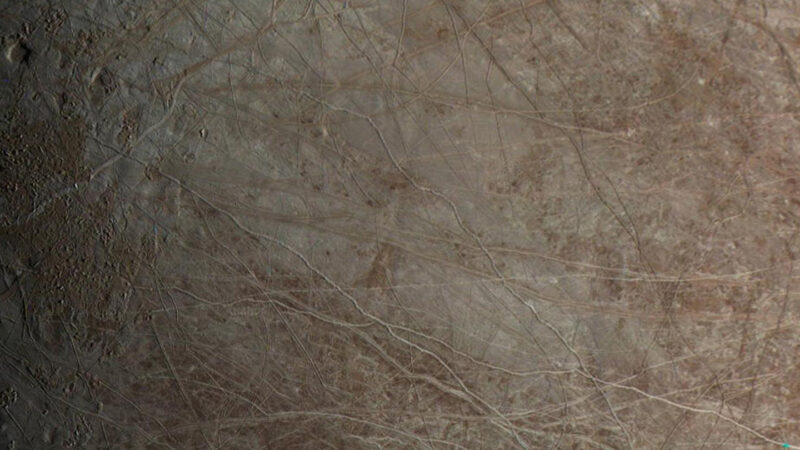
Juno’s unprecedented views of Jupiter and its moons are a gift that keeps on giving.
The NASA spacecraft was originally slated to end its mission in 2018 after completing 34 orbits of the giant planet. It’s now on orbit 47. How long scientists will get this front-row view of these worlds isn’t clear, particularly as the spacecraft zooms ever closer to the gas giant and the powerful, destructive radiation of its magnetosphere.
But Juno is tough, said space physicist Scott Bolton, principal investigator for the Juno mission, at a December 14 news conference in Chicago at the American Geophysical Union’s fall meeting. The spacecraft “is built like an armored tank, and its shields are holding,” said Bolton, of the Southwest Research Institute, which has headquarters in San Antonio.
After entering a wide orbit around Jupiter in 2016, Juno’s images quickly began to help scientists peer into the planet’s mysteries, including a geometric array of cyclones around its poles and the strange, convoluted shape of its magnetic field (SN: 3/7/18; SN: 9/5/18). Juno spied lightning storms zipping across the tops of the planet’s clouds, and revealed that Jupiter is the only planet other than Earth known to host ephemeral, lightning-generated atmospheric glows known as sprites and elves (SN: 8/5/20; SN: 11/2/20).
Juno has also passed by some of the planet’s moons, flying by Ganymede in 2021. Ganymede “is bathed by Jupiter’s magnetic field,” and Juno was able to observe, among other things, a tug of war of magnetic field lines between the planet and its moon, said space physicist Thomas Greathouse, also of the Southwest Research Institute.
In September, Juno flew by Jupiter’s moon Europa, capturing in new detail the chaotic crisscrosses of cracks, ridges and bands in the moon’s icy surface. Now the spacecraft is on its way toward Io, the innermost moon.
While Juno seems to be going strong, “the end could come in two different ways,” Bolton said. Juno could become too degraded by the intense radiation to function — or it could simply run out of propellant, which is needed to keep its antennas pointed toward Earth. If that happens, “it could be collecting data, but can’t send it back.”
 Many American diets may not include enough of this essential nutrient
  A telling hole in a Neandertal bone hints at a bitter end
  Brain implants are helping people who’ve lost their voice
  Can math stay human in the age of AI?
  Tiny implants can use the body itself to talk to each other
  Voyager 1 is nearly one light-day from Earth. What’s out there?
  Could your brain data be used against you? UN calls for limits on neurotechnology
  Ukraine: Critical health supplies destroyed in ongoing Russian attacks
  AI, green energy and economic transitions risk leaving vulnerable communities behind, UN warns
  Afghanistan faces record hunger levels amid rampant rights violations