
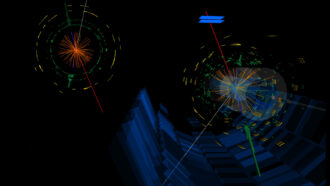
The letters “www” are typically followed by a “dot” — but not in this experiment.
Around 270 WWW events, trios of particles called W bosons, appeared in an experiment at the world’s largest particle collider, researchers report in the Aug. 5 Physical Review Letters. By measuring how often W boson triplets appear in such experiments, physicists can check their foundational theory of particle physics — the standard model — for any cracks.
To produce the rare boson triplets, scientists smashed protons together at the ATLAS experiment at the Large Hadron Collider, or LHC, near Geneva. W bosons are particles that transmit the weak force, which is responsible for certain types of radioactive decay. The particles are mysterious: In April, researchers with the now-concluded CDF experiment at Fermilab in Batavia, Ill., reported that the W boson was more massive than predicted, hinting that something may be amiss with the standard model (SN: 4/7/22).
In the new study, the probability of a WWW appearance was slightly higher than predicted by the standard model, the team found, though not enough for scientists to declare the theory flawed. “We need to accumulate more data to see how this evolves,” says ATLAS spokesperson and physicist Andreas Hoecker of CERN, the particle physics lab that is the home of the LHC.
Those proton collisions, which reached an energy of 13 trillion electron volts, occurred before the LHC shut down for upgrades in 2018. In July, the LHC restarted at a higher energy of 13.6 trillion electron volts (SN: 4/22/22). New data could help nail down whether these threes of a kind really do misbehave.
The WWW discovery is fitting — in 1989, computer scientist Tim Berners-Lee invented the World Wide Web while working at CERN.
 Horned dinosaurs’ weapons evolved to handle the forces of combat
  Artemis II results show how much science people can do at the moon
  Crossword: Time lines
  Many American diets may not include enough of this essential nutrient
  A telling hole in a Neandertal bone hints at a bitter end
  Brain implants are helping people who’ve lost their voice
  WHO scales up Ebola readiness in 22 countries across three continents
  Ukraine: Civilian casualty rates among ‘deadliest’ in years, as energy attacks intensify
  As disasters mount, next UN climate summit faces a test of trust
  Gaza: 340 children killed despite ceasefire agreement – UNICEF