
The cosmos keeps outdoing itself.
Extremely energetic light from space is an unexplained wonder of astrophysics, and now scientists have spotted this light, called gamma rays, at higher energies than ever before.
The Large High Altitude Air Shower Observatory, LHAASO, spotted more than 530 gamma rays with energies above 0.1 quadrillion electron volts, researchers report online May 17 in Nature. The highest-energy gamma ray detected was about 1.4 quadrillion electron volts. For comparison, protons in the largest accelerator on Earth, the Large Hadron Collider, reach mere trillions of electron volts. Previously, the most energetic gamma ray known had just under a quadrillion electron volts (SN: 2/2/21).
In all, the scientists spotted 12 gamma ray hot spots, hinting that the Milky Way harbors powerful cosmic particle accelerators. In order for gamma rays to reach such energies, electromagnetic fields must first rev up charged particles, namely protons or electrons, to immense speeds. Those particles can then produce energetic gamma rays, for example, when protons interact with other matter in space.
Scientists aren’t yet sure what environments are powerful enough to produce light with energies reaching more than a quadrillion electron volts. But the new observations point to two possibilities. One hot spot was associated with the Crab Nebula, the turbulent remains of an exploded star (SN: 6/24/19). Another potential source was the Cygnus Cocoon, a region where massive stars are forming, blasting out intense winds in the process.
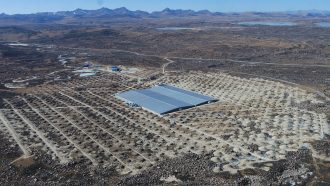
LHAASO, located on Haizi Mountain in China’s Sichuan province, is not yet fully operational. When it is completed later this year, it is expected to find even more energetic gamma rays.
 Magnetism may have helped kick-start our solar system
  Peru’s penguins are on the brink. A super El Niño could make it worse.
  These are the first feathers ever found in fossilized dinosaur poop
  See the secret to DNA hookups
  Meet the newest living cat species, the first described in 100 years
  This year’s El Niño just broke a record months before it’s expected to peak
  World News in Brief: Refugee funding, US migration policy triggers ‘cascade’ of rights violations, world forests report, restorative justice in Colombia
  From energy crisis to energy transition: How renewables are reshaping energy security
  Sudan tells UN: No imposed solutions to country’s conflict
  ‘Ballot must replace the bullets’, South Sudan tells General Assembly ahead of elections