
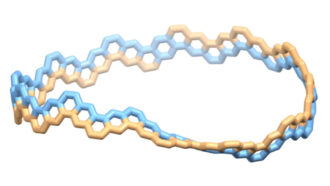
From cylindrical nanotubes to the hollow spheres known as buckyballs, carbon is famous for forming tiny, complex nanostructures (SN: 8/15/19). Now, scientists have added a new geometry to the list: a twisted strip called a Möbius carbon nanobelt.
Möbius strips are twisted bands that are famous in mathematics for their weird properties. A rubber band, for example, has an inside and an outside. But if you cut the rubber band crosswise, twist one end and glue it back together, you get a Möbius strip, which has only one face (SN: 7/24/07).
In 2017, researchers created carbon nanobelts, thin loops of carbon that are like tiny slices of a carbon nanotube. That feat suggested it might be possible to create a nanobelt with a twist, a Möbius carbon nanobelt. To make the itsy-bitsy twisty carbon, some of the same researchers stitched together individual smaller molecules using a series of 14 chemical reactions, chemist Yasutomo Segawa of the Institute for Molecular Science in Okazaki, Japan, and colleagues report May 19 in Nature Synthesis.
While carbon nanotubes can be used to make new types of computer chips and added to textiles to create fabric with unusual properties, scientists don’t yet know of any practical applications for the twisty nanobelts (SN: 8/28/19; SN: 2/8/19). But, Segawa says, the work improves scientists’ ability to make tiny carbon structures, especially complicated ones.
 A new treatment could restore some mobility in people paralyzed by strokes
  What has Perseverance found in two years on Mars?
 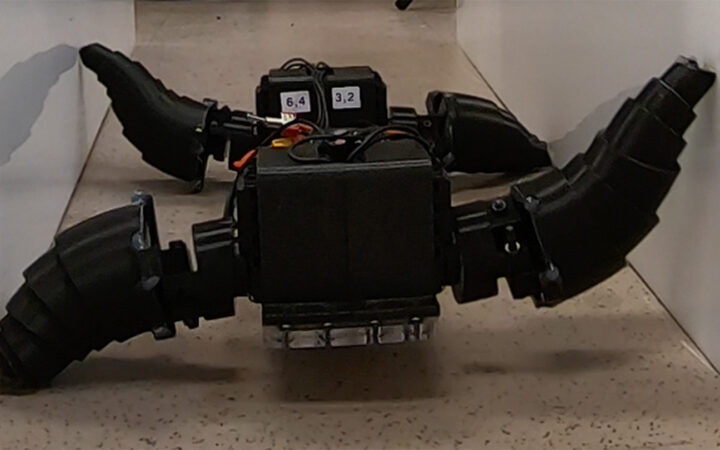 This robot automatically tucks its limbs to squeeze through spaces
  Greta Thunberg’s new book urges the world to take climate action now
 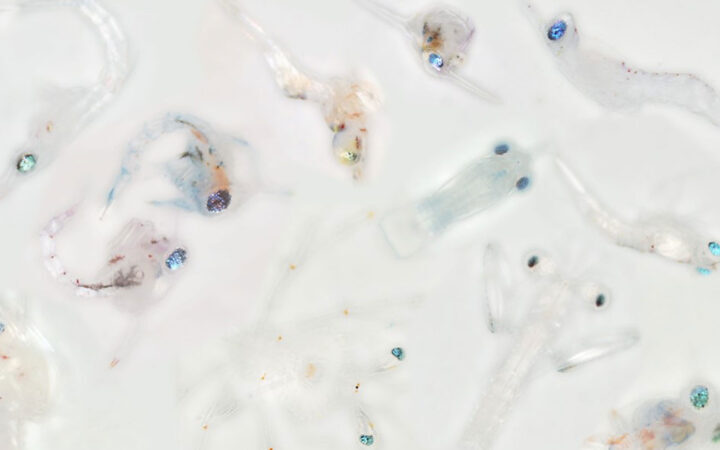 Glassy eyes may help young crustaceans hide from predators in plain sight
  A chemical imbalance doesn’t explain depression. So what does?