
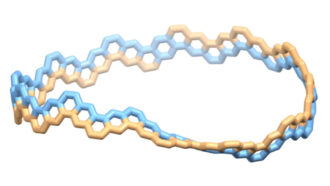
From cylindrical nanotubes to the hollow spheres known as buckyballs, carbon is famous for forming tiny, complex nanostructures (SN: 8/15/19). Now, scientists have added a new geometry to the list: a twisted strip called a Möbius carbon nanobelt.
Möbius strips are twisted bands that are famous in mathematics for their weird properties. A rubber band, for example, has an inside and an outside. But if you cut the rubber band crosswise, twist one end and glue it back together, you get a Möbius strip, which has only one face (SN: 7/24/07).
In 2017, researchers created carbon nanobelts, thin loops of carbon that are like tiny slices of a carbon nanotube. That feat suggested it might be possible to create a nanobelt with a twist, a Möbius carbon nanobelt. To make the itsy-bitsy twisty carbon, some of the same researchers stitched together individual smaller molecules using a series of 14 chemical reactions, chemist Yasutomo Segawa of the Institute for Molecular Science in Okazaki, Japan, and colleagues report May 19 in Nature Synthesis.
While carbon nanotubes can be used to make new types of computer chips and added to textiles to create fabric with unusual properties, scientists don’t yet know of any practical applications for the twisty nanobelts (SN: 8/28/19; SN: 2/8/19). But, Segawa says, the work improves scientists’ ability to make tiny carbon structures, especially complicated ones.
 Scarred blood vessels may be one clue to APOE4’s Alzheimer’s risk
  When climate change brings the heat, what happens to a mighty redwood?
  How the Grand Canyon could have lost 1 billion years of geologic history
  Here’s a look at the Nobel Prizes for science
  Kilauea’s display is revealing why volcanoes spew like a fountain show
  An experimental drug kills fat cells, rather than shrinking them
  Rise in poverty is ‘a wake-up call for the world’, UN development chief says
  ‘Efficiency has limits’: UNHCR chief warns refugee protection is buckling under cuts
  UN aid operation underway in Nepal following fresh floods