
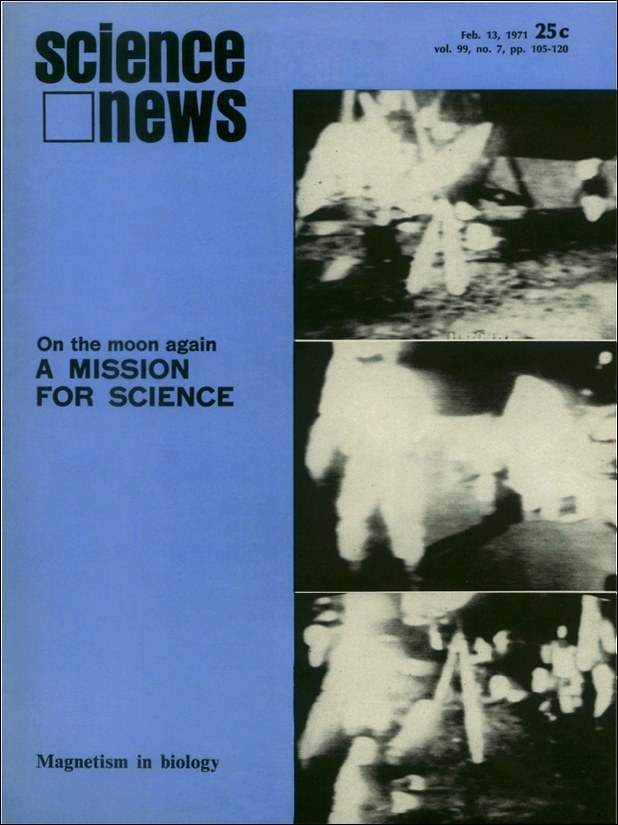
More about partons — Science News, February 13, 1971
Experiments in which protons and neutrons were bombarded with high-energy electrons have given indications that protons and neutrons are not amorphous masses but composed of distinct subparticles. The subparticles have been named partons, and whether or not they correspond to the hypothetical quarks remains a moot question.
Update
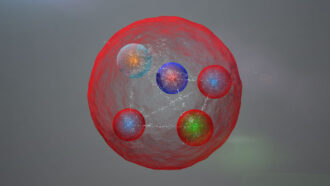
The so-called partons seen in experiments at the Stanford Linear Accelerator Center were indeed quarks — a discovery that won three researchers the 1990 Nobel Prize in physics (SN: 10/27/90, p. 263). Predicted by physicists Murray Gell-Mann and George Zweig in 1964, quarks are the building blocks of most of the universe’s ordinary matter. Quarks were originally thought to come in three varieties: up, down and strange. But particle collider experiments have revealed three additional types: charm, bottom and top (SN: 4/30/94, p. 276). Quarks usually come in pairs or trios. Recently, physicists have glimpsed more elaborate tetraquarks and pentaquarks (SN: 8/1/20, p. 14).
 Horned dinosaurs’ weapons evolved to handle the forces of combat
  Artemis II results show how much science people can do at the moon
  Crossword: Time lines
  Many American diets may not include enough of this essential nutrient
 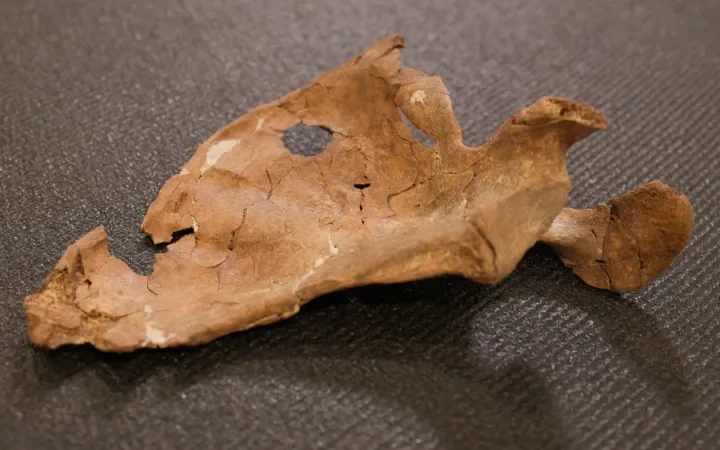 A telling hole in a Neandertal bone hints at a bitter end
  Brain implants are helping people who’ve lost their voice
  Inside the New York ‘time machine’ racing to save a century of sound and film
 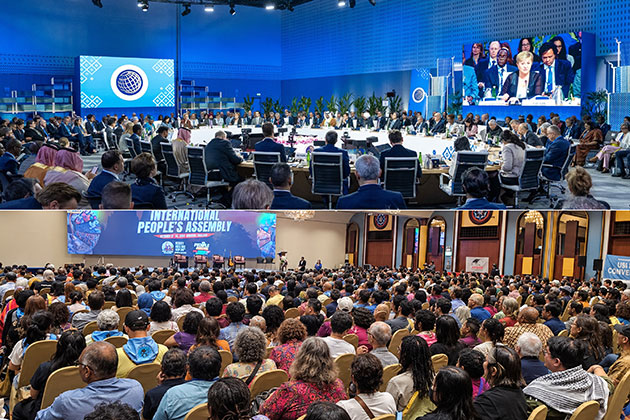 Two Summits in Bangkok: IMF/World Bank and Finance Ministers Inside, the People’s Assembly Outside
  CHINA: ‘My Sister Has Been in a Chinese Prison for Eight Years Because I Exercised My Freedom of Speech’
  COP17: The world has a plan to save nature. Is it working?