

Urea normalizes cells – Science News, December 19, 1970
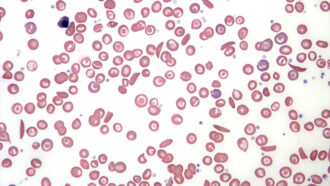
Intravenous infusions of urea now appear to promise successful treatment of sickle-cell patients.… Urea causes sickled cells to revert to their normal, doughnut shape. Thus far, intravenous infusions of urea have relieved sickle-cell crises in 22 patients tested.
Update
Sickle-cell disease causes painful clots that can lead to strokes and damage organs. Bone marrow transplants, which began in the 1980s for sickle-cell patients, are a cure, but finding a donor can be challenging. In 1998, a urea-based compound called hydroxyurea became the first drug approved by the U.S. Food and Drug Administration to treat sickle-cell disease. Until then, without a transplant, doctors could only ease symptoms with painkillers and blood transfusions.
Hydroxyurea is still used today. Because the compound can be toxic at high doses, scientists have continued searching for better treatments. Clinical trials under way in the United States are using the gene-editing tool CRISPR/Cas9 to edit sickle-cell patients’ DNA in an effort to beat the disease for good (SN: 8/31/19, p. 6).
 A nanoparticle revealed the tiny impact of a single gas atom
  Was van Gogh’s ‘The Starry Night’ a flight of fancy or a real sky?
  This ‘living drug’ could change the course of autoimmune disease
  AI could turn scientific papers into research assistants
  A lifesaving medication is not behind the drop in U.S. overdose deaths
  Peek into hidden worlds revealed by the 2026 Nikon Small World contest
  ‘Connect the dots’ between street protests and global turmoil, urges Guterres
  DR Congo: Ebola responders under pressure as outbreak expands