

Urea normalizes cells – Science News, December 19, 1970
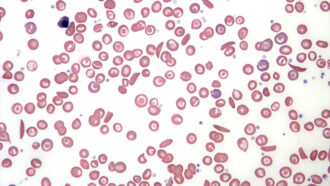
Intravenous infusions of urea now appear to promise successful treatment of sickle-cell patients.… Urea causes sickled cells to revert to their normal, doughnut shape. Thus far, intravenous infusions of urea have relieved sickle-cell crises in 22 patients tested.
Update
Sickle-cell disease causes painful clots that can lead to strokes and damage organs. Bone marrow transplants, which began in the 1980s for sickle-cell patients, are a cure, but finding a donor can be challenging. In 1998, a urea-based compound called hydroxyurea became the first drug approved by the U.S. Food and Drug Administration to treat sickle-cell disease. Until then, without a transplant, doctors could only ease symptoms with painkillers and blood transfusions.
Hydroxyurea is still used today. Because the compound can be toxic at high doses, scientists have continued searching for better treatments. Clinical trials under way in the United States are using the gene-editing tool CRISPR/Cas9 to edit sickle-cell patients’ DNA in an effort to beat the disease for good (SN: 8/31/19, p. 6).
 A new map points out U.S. rivers most worth protecting
  Exhaling may speed up reaction times
  A medieval remedy could offer ideas for beating antibiotic resistance
  In the wake of the flood, could Nepal avert the next disaster?
  ‘The Deep End’ podcast is back to explore what makes your voice yours
  Magnetism may have helped kick-start our solar system
  Lebanon: one in five children goes to bed hungry, says UNICEF
  Malaysia: UN agency urges safeguards after refugees returned to Myanmar
  New Ocean Report Warns of Rising Seas, Ocean Heat and Acidification