
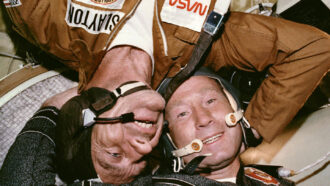
A busy week for science in Moscow — Science News, June 3, 1972
U.S. and Soviet leaders … signed agreements on space, science and technology, health and the environment…. The space agreement … outlines plans for cooperation in fields such as meteorology, study of the natural environment, planetary exploration and space biology.
Update
The 1972 space agreement led to the first international human spaceflight, the Apollo-Soyuz mission, during which Soviet and U.S. crews socialized in space (SN: 7/26/75, p. 52). Apollo-Soyuz encouraged decades of collaboration that continues today on the International Space Station. Now, Russia’s war in Ukraine has prompted many countries to pull back on scientific endeavors with Russia, in space and on Earth (SN: 3/26/22, p. 6). While NASA remains committed to the space station, the head of Russia’s space agency has threatened to end the cooperation in retaliation for sanctions imposed in response to the war. Russia has yet to make moves to abandon the station, though the country has ceased supplying rocket engines to the United States.
 Was the ‘American cheetah’ a cheetah at all?
  AI agents aren’t ready to replace humans in behavioral research
  A culprit for corrosion may have been operating under our noses
  New Hubble images reveal a bizarre decagon over Saturn’s south pole
  A massive study unveils the genetic underpinnings of fibromyalgia
  The universe may have been building rocky planets almost from the start
  UN aims to raise nearly $50 million for Nepal flood response
  West Bank: UN rights report warns of forcible displacement from three refugee camps
  UN tells the world: Stop making Africa look small
  Repeated attacks on humanitarian warehouses put vital medical aid at risk in Ukraine: WHO