
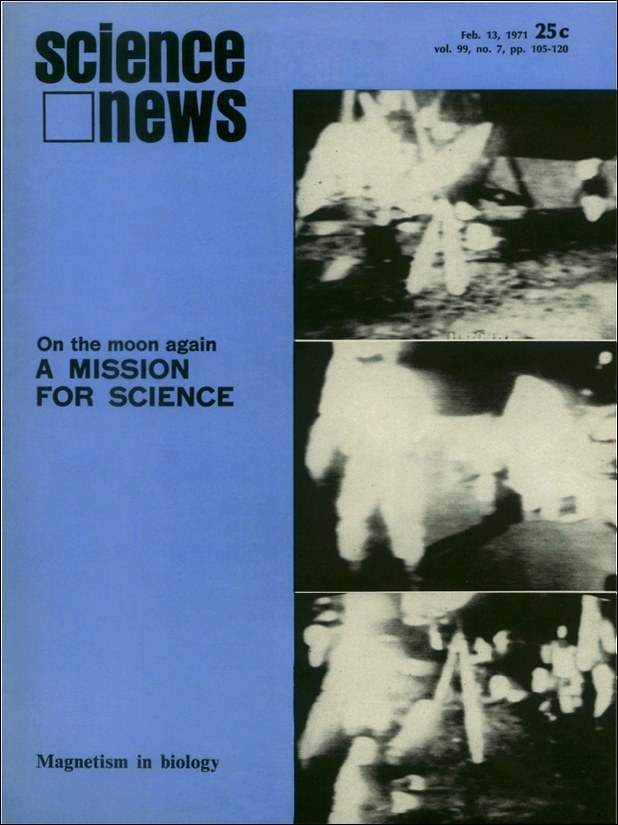
More about partons — Science News, February 13, 1971
Experiments in which protons and neutrons were bombarded with high-energy electrons have given indications that protons and neutrons are not amorphous masses but composed of distinct subparticles. The subparticles have been named partons, and whether or not they correspond to the hypothetical quarks remains a moot question.
Update
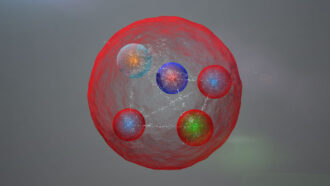
The so-called partons seen in experiments at the Stanford Linear Accelerator Center were indeed quarks — a discovery that won three researchers the 1990 Nobel Prize in physics (SN: 10/27/90, p. 263). Predicted by physicists Murray Gell-Mann and George Zweig in 1964, quarks are the building blocks of most of the universe’s ordinary matter. Quarks were originally thought to come in three varieties: up, down and strange. But particle collider experiments have revealed three additional types: charm, bottom and top (SN: 4/30/94, p. 276). Quarks usually come in pairs or trios. Recently, physicists have glimpsed more elaborate tetraquarks and pentaquarks (SN: 8/1/20, p. 14).
 Was the ‘American cheetah’ a cheetah at all?
  AI agents aren’t ready to replace humans in behavioral research
  A culprit for corrosion may have been operating under our noses
  New Hubble images reveal a bizarre decagon over Saturn’s south pole
  A massive study unveils the genetic underpinnings of fibromyalgia
  The universe may have been building rocky planets almost from the start
  Coordinated action on clean air and climate change can net $15 for every dollar spent
  Human rights chief Türk renews call for end to spiralling Sudan war
  AI: Türk urges action before it becomes an ‘existential risk to humanity’
  UNGA 81: A United Nations at a Turning Point