
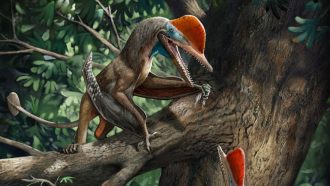
Future Jurassic Park films could feature one weird new beast in the menagerie: a pterosaur nicknamed Monkeydactyl for its opposable thumbs.
This flying reptile from the Jurassic Period may be the earliest known animal that could touch the insides of its thumbs to the insides of its other fingers, researchers report online April 12 in Current Biology. Such dexterity probably allowed Monkeydactyl to climb trees about 160 million years ago, perhaps to feed on insects and other prey that nonclimbing pterosaurs did not, the researchers say (SN: 12/21/18). The latter half of the creature’s official name, Kunpengopterus antipollicatus, comes from the words “opposite” and “thumb” in ancient Greek.
Monkeydactyl’s fossilized remains, unearthed in northeastern China in 2019, are embedded in rock. So the team used micro-CT scanning to create a 3-D rendering of the fossil. “With this detail, we’re able to look at the fossil from any angle, and make sure that the bones are in their right [original] place,” says study coauthor Rodrigo Pêgas, a paleontologist at the Federal University of ABC in São Bernardo, Brazil.
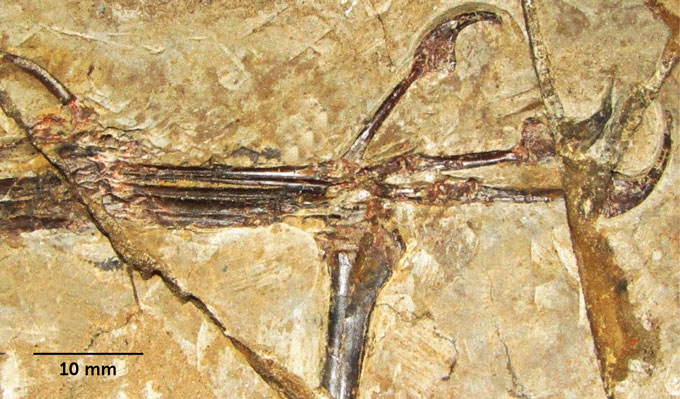
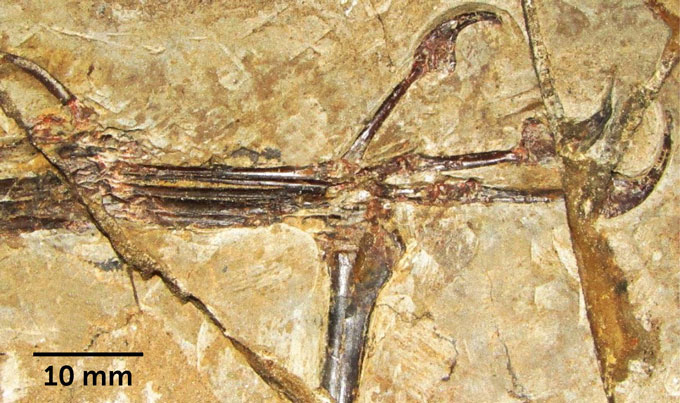
Those scans helped confirm that the skeleton had a well-preserved opposable thumb on each hand. “Almost all of the modern animals that have opposable thumbs use them to climb trees,” Pêgas says, including primates and some tree frogs. That evidence, along with the apparent flexibility of Monkeydactyl’s joints, suggests this species was well suited to clambering through tree branches.
 Magnetism may have helped kick-start our solar system
  Peru’s penguins are on the brink. A super El Niño could make it worse.
  These are the first feathers ever found in fossilized dinosaur poop
  See the secret to DNA hookups
  Meet the newest living cat species, the first described in 100 years
  This year’s El Niño just broke a record months before it’s expected to peak
  World News in Brief: Refugee funding, US migration policy triggers ‘cascade’ of rights violations, world forests report, restorative justice in Colombia
  From energy crisis to energy transition: How renewables are reshaping energy security
  Sudan tells UN: No imposed solutions to country’s conflict
  ‘Ballot must replace the bullets’, South Sudan tells General Assembly ahead of elections