

Future Jurassic Park films could feature one weird new beast in the menagerie: a pterosaur nicknamed Monkeydactyl for its opposable thumbs.
This flying reptile from the Jurassic Period may be the earliest known animal that could touch the insides of its thumbs to the insides of its other fingers, researchers report online April 12 in Current Biology. Such dexterity probably allowed Monkeydactyl to climb trees about 160 million years ago, perhaps to feed on insects and other prey that nonclimbing pterosaurs did not, the researchers say (SN: 12/21/18). The latter half of the creature’s official name, Kunpengopterus antipollicatus, comes from the words “opposite” and “thumb” in ancient Greek.
Monkeydactyl’s fossilized remains, unearthed in northeastern China in 2019, are embedded in rock. So the team used micro-CT scanning to create a 3-D rendering of the fossil. “With this detail, we’re able to look at the fossil from any angle, and make sure that the bones are in their right [original] place,” says study coauthor Rodrigo Pêgas, a paleontologist at the Federal University of ABC in São Bernardo, Brazil.
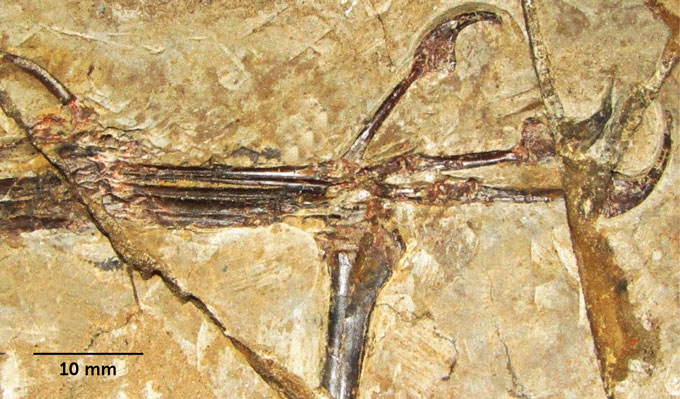
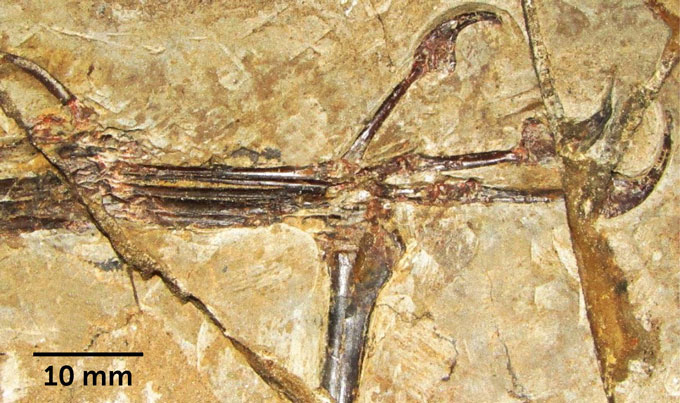
Those scans helped confirm that the skeleton had a well-preserved opposable thumb on each hand. “Almost all of the modern animals that have opposable thumbs use them to climb trees,” Pêgas says, including primates and some tree frogs. That evidence, along with the apparent flexibility of Monkeydactyl’s joints, suggests this species was well suited to clambering through tree branches.
 Horned dinosaurs’ weapons evolved to handle the forces of combat
  Artemis II results show how much science people can do at the moon
  Crossword: Time lines
  Many American diets may not include enough of this essential nutrient
  A telling hole in a Neandertal bone hints at a bitter end
  Brain implants are helping people who’ve lost their voice
  COP17: The world has a plan to save nature. Is it working?
  Flour sacks turned flood barriers: Gaza faces another winter without safe shelter
  WHO scales up Ebola readiness in 22 countries across three continents
  Ukraine: Civilian casualty rates among ‘deadliest’ in years, as energy attacks intensify