
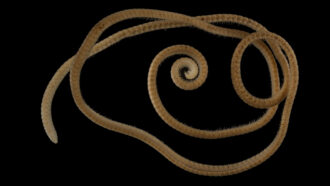
Millipedes, as we’ve known them, have been a lie. The Latin name for the arthropods implies an impressive set of 1,000 feet. Yet no millipede with more than 750 legs has ever been found, until now.
The first millipede that lives up to its name uses its 1,306 little legs to tunnel through soil deep beneath the semi-arid scrubland of Western Australia, researchers report December 16 in Scientific Reports. Dubbed Eumillipes persephone, it’s the leggiest creature ever known to crawl Earth.
Researchers nabbed the specimen and seven other curiously long, threadlike millipedes by dropping cups baited with leaf litter into drill holes used for mineral prospecting that were up to 60 meters deep. Eventually, the creatures were sent to entomologist Paul Marek at Virginia Tech in Blacksburg for a closer look.
Eumillipes persephone has hundreds of tiny legs on its underside, as revealed in this microscope image of a male. The millipede’s many legs help the creature tunnel through soil up deep below Earth’s surface.P.E. Marek et al/Scientific Reports 2021
The pale, cream-colored millipedes lack eyes, and massive antennae protrude from their drill bit–shaped heads — all signs of a subterranean lifestyle, Marek says. While inspecting a 95-millimeter-long female under a microscope, Marek realized he beheld something special. “I was like, Oh my god this has more than 1,000 legs,” he says. With 1,306 tiny feet in total, the specimen has nearly double that of the previous record-holder (SN: 6/7/06). “It’s pretty astounding.”
The researchers suspect E. persephone’s elongate, leg-packed body helps the creature maneuver through soil in up to eight different directions at once, like a tangled strand of mobile pasta. “We suspect it feeds on fungi,” Marek says, but the types of fungi living in these deep, dark habitats are unknown.
While E. persephone still holds many secrets, Marek is sure of one thing: “Textbooks are going to have to be changed,” he says. Paragraphs on millipedes will no longer require the caveat that technically, the name is a misnomer. “We finally have a real millipede.”
 Was the ‘American cheetah’ a cheetah at all?
  AI agents aren’t ready to replace humans in behavioral research
  A culprit for corrosion may have been operating under our noses
  New Hubble images reveal a bizarre decagon over Saturn’s south pole
  A massive study unveils the genetic underpinnings of fibromyalgia
  The universe may have been building rocky planets almost from the start
  As wildfires spread north, UN agencies race to help Europe adapt
  Central Park adapts to climate change while helping New York stay cool
  UN aims to raise nearly $50 million for Nepal flood response
  West Bank: UN rights report warns of forcible displacement from three refugee camps