
Millipedes, as we’ve known them, have been a lie. The Latin name for the arthropods implies an impressive set of 1,000 feet. Yet no millipede with more than 750 legs has ever been found, until now.
The first millipede that lives up to its name uses its 1,306 little legs to tunnel through soil deep beneath the semi-arid scrubland of Western Australia, researchers report December 16 in Scientific Reports. Dubbed Eumillipes persephone, it’s the leggiest creature ever known to crawl Earth.
Researchers nabbed the specimen and seven other curiously long, threadlike millipedes by dropping cups baited with leaf litter into drill holes used for mineral prospecting that were up to 60 meters deep. Eventually, the creatures were sent to entomologist Paul Marek at Virginia Tech in Blacksburg for a closer look.
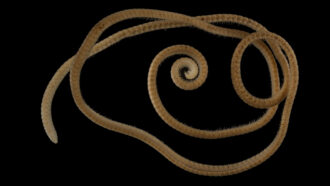
Eumillipes persephone has hundreds of tiny legs on its underside, as revealed in this microscope image of a male. The millipede’s many legs help the creature tunnel through soil up deep below Earth’s surface.P.E. Marek et al/Scientific Reports 2021
The pale, cream-colored millipedes lack eyes, and massive antennae protrude from their drill bit–shaped heads — all signs of a subterranean lifestyle, Marek says. While inspecting a 95-millimeter-long female under a microscope, Marek realized he beheld something special. “I was like, Oh my god this has more than 1,000 legs,” he says. With 1,306 tiny feet in total, the specimen has nearly double that of the previous record-holder (SN: 6/7/06). “It’s pretty astounding.”
The researchers suspect E. persephone’s elongate, leg-packed body helps the creature maneuver through soil in up to eight different directions at once, like a tangled strand of mobile pasta. “We suspect it feeds on fungi,” Marek says, but the types of fungi living in these deep, dark habitats are unknown.
While E. persephone still holds many secrets, Marek is sure of one thing: “Textbooks are going to have to be changed,” he says. Paragraphs on millipedes will no longer require the caveat that technically, the name is a misnomer. “We finally have a real millipede.”
 A quantum computing feat brings the ‘megaquops’ era a step closer
  AI can give you your voice back
  These tiny snakes cartwheel to escape danger
  Japan’s sample return mission to Phobos may also collect some Mars dust
  Horned dinosaurs’ weapons evolved to handle the forces of combat
  Artemis II results show how much science people can do at the moon
  As El Niño Returns, East Africa’s Urban Poor Brace for Heavy Rains
  Hunger is ‘an avoidable tragedy’ in a world of plenty: Türk