
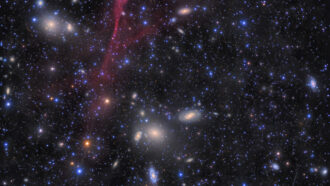
A cloud of expanding gas in space is the largest supernova remnant ever seen in the sky, a new study confirms.
The Milky Way has some 300 known supernova remnants, each made of debris from an exploded star mixed with interstellar material swept up by the blast. This supersized one, located in the constellation Antlia, isn’t necessarily the biggest of all physically, but thanks to its proximity to us, it looks the biggest. As seen from Earth, it spans a region of sky more than 40 times the size of a full moon, astronomer Robert Fesen of Dartmouth College and his colleagues report February 25 at arXiv.org. The Antlia remnant appears about three times as large as the previous champion, the Vela supernova remnant (SN: 7/8/20).
The star that created the Antlia supernova remnant exploded roughly 100,000 years ago. Estimates of the remnant’s distance vary, so its physical size has yet to be nailed down. But if the cloud is 1,000 light-years away, then it’s about 390 light-years across; if it’s twice as far, then it’s twice as big. Either way, it’s considerably larger than the Vela supernova remnant, which is about 100 light-years wide.
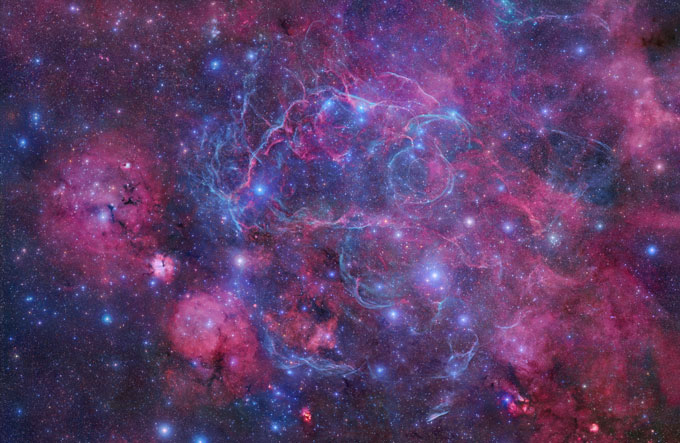
The Antlia remnant isn’t new to astronomers. In 2002, researchers discovered the cloud and proposed that it is the nearby remains of a supernova, based on the red glow of its hydrogen atoms as well as its X-ray emission. But hardly anyone had observed the object since. “It wasn’t really firmly established as a supernova remnant,” says team member John Raymond, an astronomer at the Harvard-Smithsonian Center for Astrophysics in Cambridge, Mass.
So the astronomers studied the cloud at visible and ultraviolet wavelengths, which demonstrate that the Antlia object is indeed a supernova remnant. In particular, the visible light shows spectral signatures of shock waves, which result when high-speed gas from a supernova slams into gas around it.
“The evidence for it being shocks in a supernova remnant seems to be very good,” says Roger Chevalier, an astronomer at the University of Virginia in Charlottesville not involved with the new work. He notes that the team detected red light from sulfur atoms that are missing one electron, a hallmark of shocks in supernova remnants.
The astronomer who discovered the object two decades ago had little doubt it was a genuine supernova remnant. “They’ve done good work,” says Peter McCullough at the Space Telescope Science Institute in Baltimore. “This is a case where it looks like a duck, quacks like a duck, walks like a duck and now someone else 20 years later comes along and says, `Not only that, it has feathers.’”
 Horned dinosaurs’ weapons evolved to handle the forces of combat
  Artemis II results show how much science people can do at the moon
  Crossword: Time lines
  Many American diets may not include enough of this essential nutrient
  A telling hole in a Neandertal bone hints at a bitter end
  Brain implants are helping people who’ve lost their voice
  Inside the New York ‘time machine’ racing to save a century of sound and film
  Two Summits in Bangkok: IMF/World Bank and Finance Ministers Inside, the People’s Assembly Outside
  CHINA: ‘My Sister Has Been in a Chinese Prison for Eight Years Because I Exercised My Freedom of Speech’
  COP17: The world has a plan to save nature. Is it working?