
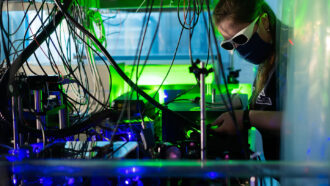
In terms of difficulty, trapping a plasma is right up there with catching a cloud and pinning it down, or holding a moonbeam in your hand. But physicists have devised a new way to magnetically bottle an ultracold plasma in the lab.
Using magnetism to trap frigid plasmas, in which particles move around sluggishly, could allow physicists to study plasma behavior in slow motion, researchers report in the Feb. 26 Physical Review Letters. That may reveal new details about how plasmas behave in much hotter, more frenetic environments — such as the roiling interiors of fusion reactors or stars (SN: 1/27/16).
“It takes a lot of tricks” to stopper a cold plasma, says physicist Thomas Killian of Rice University in Houston. He and colleagues first boiled a lump of strontium metal and channeled that vapor down a tube. There, light from a laser beam slowed the atoms almost to a standstill — effectively cooling them to just three-thousandths of a degree above absolute zero (–273° Celsius). Using a second laser, the researchers knocked an electron off each atom, creating a plasma of negatively charged electrons and positive strontium ions.
This ionized gas couldn’t be stashed inside an ordinary container. “We have to completely isolate this plasma,” Killian says. “If it bumps into a wall, [the particles] will just stick to the wall … or the wall will heat it up,” because even room-temperature equipment is much warmer than the plasma. Left out in the open, the plasma would dissipate within tens of microseconds. So Killian’s team created their plasma between two coils of electric current, which formed opposing magnetic fields. These equal and opposite magnetic forces on the charged particles held the plasma together for up to 500 microseconds.
 Horned dinosaurs’ weapons evolved to handle the forces of combat
  Artemis II results show how much science people can do at the moon
  Crossword: Time lines
  Many American diets may not include enough of this essential nutrient
  A telling hole in a Neandertal bone hints at a bitter end
  Brain implants are helping people who’ve lost their voice
  Inside the New York ‘time machine’ racing to save a century of sound and film
  Two Summits in Bangkok: IMF/World Bank and Finance Ministers Inside, the People’s Assembly Outside
  CHINA: ‘My Sister Has Been in a Chinese Prison for Eight Years Because I Exercised My Freedom of Speech’
  COP17: The world has a plan to save nature. Is it working?