
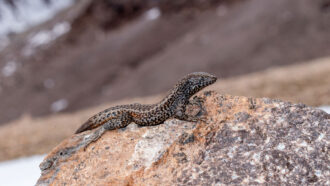
High in the Peruvian Andes, a lizard has claimed the title of world’s highest altitude reptile. The lizard was spotted as high as 5,400 meters in elevation, exposed to frigid temperatures, intense ultraviolet radiation and low oxygen, researchers report February 15 in Herpetozoa.
In October 2020, zoologist José Cerdeña and colleagues ascended Peru’s Chachani volcano, which rises 6,057 meters above sea level. The team was looking for Liolaemus lizards, also known as tree iguanas, and found them as the researchers climbed above 5,000 meters.
“We observed something moving between the rocks,” says Cerdeña, of the National University of Saint Augustine in Arequipa, Peru. “At first we thought they were mice.” After getting a closer look, he and his team saw that the darting animals were actually lizards, tentatively identified as Liolaemus tacnae. The species is known to survive at high altitude areas in Peru, and at least one population near Chachani was previously spotted some 4,000 meters above sea level.
Survival in such forbidding conditions is hard enough for mammals (SN: 7/29/20). But cold-blooded reptiles face additional temperature regulation obstacles, so records of reptiles this high are rare. Until now, the highest living reptile was a cold-hardy species of toad-headed agama lizard (Phrynocephalus erythrurus) living on the Tibetan Plateau at 5,300 meters. The Andean lizard breaks the old record by 100 meters.
It’s somewhat fitting that the record goes to a species of Liolaemus lizard. The genus is exceptionally diverse, with more than 270 species adapted to a wide range of habitats all over South America.
Climate change could have facilitated Liolaemus’ status as a record holder, Cerdeña notes, as colder conditions have retreated up mountain peaks in the face of warming. “It is possible that this lizard species began to colonize this altitude recently,” he says.
The research group’s next steps are to verify the identification of the lizard with physical and genetic analysis, Cerdeña says. He also wants to know more about the reptile’s physiology, which may hold secrets to its high-altitude lifestyle.
 Horned dinosaurs’ weapons evolved to handle the forces of combat
  Artemis II results show how much science people can do at the moon
  Crossword: Time lines
  Many American diets may not include enough of this essential nutrient
  A telling hole in a Neandertal bone hints at a bitter end
  Brain implants are helping people who’ve lost their voice
  Inside the New York ‘time machine’ racing to save a century of sound and film
  Two Summits in Bangkok: IMF/World Bank and Finance Ministers Inside, the People’s Assembly Outside
  CHINA: ‘My Sister Has Been in a Chinese Prison for Eight Years Because I Exercised My Freedom of Speech’
  COP17: The world has a plan to save nature. Is it working?