
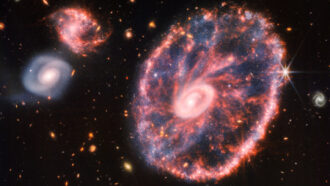
It’s not easy being ringed. A newly released image from the James Webb Space Telescope, or JWST, shows the Cartwheel Galaxy still reeling from a run-in with a smaller galaxy 400 million years ago.
The Cartwheel Galaxy, so called because of its bright inner ring and colorful outer ring, lies about 500 million light-years from Earth. Astronomers think it used to be a large spiral like the Milky Way, until a smaller galaxy smashed through it. In earlier observations with other telescopes, the space between the rings appeared shrouded in dust.
Now, JWST’s infrared cameras have peered through the dust and found previously unseen stars and structure (SN: 7/11/22). The new image shows sites of intense star formation throughout the galaxy that were triggered by the collision’s aftereffects. Some of those new stars are forming in spokelike patterns between the central ring and the outer ring, a process that is not well understood.
When the Hubble Space Telescope observed the Cartwheel Galaxy in visible light (left), the spokes between the galaxy’s bright rings were barely visible wisps. JWST’s infrared eyes brought them into vivid focus (right). Near-infrared light (blue, orange and yellow) traces newly forming stars; mid-infrared light (red) highlights the galaxy’s chemistry.Left: Hubble/NASA and ESA; Right: NASA, ESA, CSA, STScI and Webb ERO Production Team
Ring galaxies are rare, and galaxies with two rings are even more unusual. That strange shape means that the long-ago collision set up multiple waves of gas rippling back and forth in the galaxy left behind. It’s like if you drop a pebble in the bathtub, says JWST project scientist Klaus Pontoppidan of the Space Telescope Science Institute in Baltimore. “First you get this ring, then it hits the walls of your bathtub and reflects back, and you get a more complicated structure.”
The effect probably means that the Cartwheel Galaxy has a long road to recovery ahead — and astronomers don’t know what it will look like in the end.
As for the smaller galaxy that caused all this mayhem, it didn’t stick around to get its picture taken. “It’s gone off on its merry way,” Pontoppidan says.
 These mice have human (nerve cells) on the brain
  The U.S. has weapons in space. Here’s what that could mean
  Alzheimer’s damage may begin outside the brain
  Meet Swiftiephylus, an Australian bug named after Taylor Swift
  ‘Bogland’ explores beautifully strange ecosystems
  Feeling nervous? Work the system
  UN report warns of reprisals against those who collaborate in defence of human rights
  Gaza: At least 20 killed in deadly building collapse, search for survivors continues
  Security Council LIVE: ‘Being a woman is a crime in Afghanistan,’ civil society briefer declares
  AI, climate and conflicts top Guterres’s agenda ahead of General Assembly