
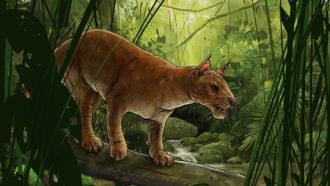
Nearly 42 million years ago, a fearsome bobcat-sized creature prowled the forests of what is now San Diego. Unlike most animals at the time, it was a hypercarnivore, built to eat meat and almost only meat.
Meet Diegoaelurus vanvalkenburghae — a newly identified species of the mysterious and now-extinct Machaeroidine family, thought to be the first mammals with saberlike fangs and sharp slicing teeth.
Until now, only about a dozen other Machaeroidine fossils have been described, most from Wyoming but a few from Asia. Paleontologists identified this new predator, described March 15 in PeerJ, thanks to a 71-millimeter-long lower jawbone with teeth that was originally found in a San Diego County fossil bed.
The fossil gives away that the creature had long saberlike canine teeth because the bony chin is downturned, to protect the fangs, and there is a gap in the lower teeth to fit them, says Ashley Poust, a paleontologist at the San Diego Natural History Museum. The canines themselves weren’t recovered.
“Those big fangs were either used to bite into the throat of the prey or were used to rip and tear the flesh,” Poust says. “This fossil, in particular, helps us understand what the whole food web would’ve looked like.… Now we know that there might have been this crazy saber-toothed animal stalking primates in the branches or maybe stalking the tapirs in the leaves below.”
Today’s hypercarnivores range from massive polar bears and fierce tigers to your cuddly (or not) housecat. But that lifestyle was uncommon for predators of the Eocene Epoch, which ended around 34 million years ago, and there aren’t a lot of these carnivores known from that time.
So D. vanvalkenburghae provides an early glimpse into how animals independently evolved the ability to slice flesh with ease (SN: 5/31/19). Such daggerlike fangs have turned up in a wide range of ancient animals from anchovies to the much more recent saber-toothed cats such as Smilodon, which appeared on Earth millions of years after D. vanvalkenburghae went extinct (SN: 5/18/20; SN: 3/24/19).
 A quantum computing feat brings the ‘megaquops’ era a step closer
  AI can give you your voice back
  These tiny snakes cartwheel to escape danger
  Japan’s sample return mission to Phobos may also collect some Mars dust
  Horned dinosaurs’ weapons evolved to handle the forces of combat
  Artemis II results show how much science people can do at the moon
  As El Niño Returns, East Africa’s Urban Poor Brace for Heavy Rains
  Hunger is ‘an avoidable tragedy’ in a world of plenty: Türk