
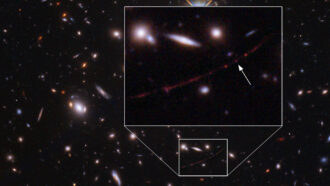
A chance alignment may have revealed a star from the universe’s first billion years.
If confirmed, this star would be the most distant one ever seen, obliterating the previous record (SN: 7/11/17). Light from the star traveled for about 12.9 billion years on its journey toward Earth, about 4 billion years longer than the former record holder, researchers report in the March 30 Nature. Studying the object could help researchers learn more about the universe’s composition during that early, mysterious time.
“These are the sorts of things that you only hope you could discover,” says astronomer Katherine Whitaker of the University of Massachusetts Amherst, who was not part of the new study.
The researchers found the object while analyzing Hubble Space Telescope images of dozens of clusters of galaxies nearer to Earth. These clusters are so massive that they bend and focus the light from more distant background objects, what’s known as gravitational lensing (SN: 10/6/15).
In images of one cluster, astronomer Brian Welch of Johns Hopkins University and colleagues noticed a long, thin, red arc. The team realized that the arc was a background galaxy whose light the cluster had warped and amplified.
Atop that red arc is a bright spot that is too small to be a small galaxy or a star cluster, the researchers say. “We stumbled into finding that this was a lensed star,” Welch says.
The researchers estimate that the star’s light originates from only 900 million years after the Big Bang, which took place about 13.8 billion years ago.
Welch and his colleagues think that the object, which they poetically nicknamed “Earendel” from the old English word meaning “morning star” or “rising light,” is a behemoth with at least 50 times the mass of the sun. But the researchers can’t pin down that value, or learn more about the star or even confirm that it is a star, without more detailed observations.
The researchers plan to use the recently launched James Webb Space Telescope to examine Earendel (SN: 10/6/21). The telescope, also known as JWST, will begin studying the distant universe this summer.
JWST may uncover objects from even earlier times in the universe’s history than what Hubble can see because the new telescope will be sensitive to light from more distant objects. Welch hopes that the telescope will find many more of these gravitationally lensed stars. “I’m hoping that this record won’t last very long.”
 Rule breaking by just a few people can be contagious
  A quantum computing feat brings the ‘megaquops’ era a step closer
  AI can give you your voice back
  These tiny snakes cartwheel to escape danger
  Japan’s sample return mission to Phobos may also collect some Mars dust
  Horned dinosaurs’ weapons evolved to handle the forces of combat
  ‘One step away from famine’: Inside Afghanistan’s hunger crisis
  Bangladesh: UNICEF chief calls for an end to child marriage
  Yemen war continues to force families from homes amid hunger and disease