
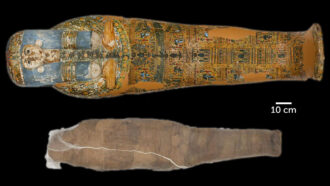
An unusual mud-wrapped mummy is leading archaeologists to rethink how nonroyal Egyptians preserved their dead.
CT scans of an Egyptian mummy from around 1,200 B.C. reveal that the body is sheathed in a mud shell between its layers of linen wrappings. Ancient Egyptians may have used this preservation technique, never before seen in Egyptian archaeology, to repair damage to the mummified body and mimic royal burial customs, researchers report February 3 in PLOS ONE.
While the mummy’s legs are caked with mud about 2.5 centimeters thick, the mud over its face is spread as thin as 1.5 millimeters. Chemical analyses of mud flakes from around the head indicate that the mud layer is covered in a white, possibly limestone-based pigment, topped with a red mineral paint.
Leg fractures and other damage to the mummy’s body hint that the mud wrap may have been used to restore the body after it was desecrated, potentially by tomb robbers. Repairing the body would have ensured that the deceased could continue existing in the afterlife.
The mud shell may also have been a poor man’s version of the expensive resin coatings seen on royal mummies of this era, the researchers suggest (SN: 8/18/14). “Status in Egyptian society was in large part measured by proximity to the king,” says Karin Sowada, an archaeologist at Macquarie University in Sydney. So imitating royal funerary practices may have been a display of social status.
The identity and social standing of the mud-wrapped individual remains a mystery. Analyzing other nonroyal mummies from ancient Egypt may reveal how common mud shells were, who used them and why.
 These tiny snakes cartwheel to escape danger
  Japan’s sample return mission to Phobos may also collect some Mars dust
  Horned dinosaurs’ weapons evolved to handle the forces of combat
  Artemis II results show how much science people can do at the moon
  Crossword: Time lines
  Many American diets may not include enough of this essential nutrient
  Protecting Earth’s fragile biodiversity takes spotlight at Armenia talks
  Gaza: Funding cuts leave half a million without food assistance
  Afro-Brazilian Religious Communities Face Mounting Discrimination Amid the Climate Crisis