
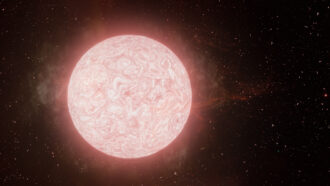
A star’s death usually comes without warning. But an early sign of one star’s imminent demise hints at what happens before some stellar explosions.
In a last hurrah before exploding, a star brightened, suggesting that it blasted some of its outer layers into space. It’s the first time scientists have spotted a pre-explosion outburst from a run-of-the-mill type of exploding star, or supernova, researchers report in the Jan. 1 Astrophysical Journal.
Scientists have previously seen harbingers of unusual types of supernovas. But “what’s nice about this one is it’s a much more normal, vanilla … supernova that’s showing this eruption before explosion,” says astronomer Mansi Kasliwal of Caltech, who was not involved with the research.
On September 16, 2020, scientists discovered the explosion of a star roughly 10 times as massive as the sun, located about 120 million light-years away. Thankfully, telescopes that regularly survey a swath of the sky, as part of an effort called the Young Supernova Experiment, had been observing the star well before it detonated. About 130 days before the explosion, the star brightened, the researchers found, the start of a pre-explosion eruption.
The final explosion was a commonplace type of stellar detonation called a type 2 supernova, which occurs when the core of an aging star collapses. Precursors to such explosions probably hadn’t been seen before because the early eruptions are faint. For this supernova, scientists had observations of the star sensitive enough to pick up the relatively weak eruption.
Previous post-explosion observations of such supernovas have hinted that the stars slough off layers before death. In 2021, astronomers reported signs of a supernova’s shock wave plowing into material that the star had expelled (SN: 11/2/21). A similar sign of cast-off stellar material was also found in the new study.
Scientists aren’t sure exactly what causes such early outbursts. They could be the result of events happening deep within a star, for example, as the star burns different types of fuel as it nears death. If more such events are found, scientists may eventually be able to predict which stars will go boom, and when.
Precursor outbursts are a sign that stars experience inner turmoil before exploding, says study coauthor Raffaella Margutti, an astrophysicist at the University of California, Berkeley. “The main message that we are getting from the universe is that these stars are really knowing that the end is coming.”
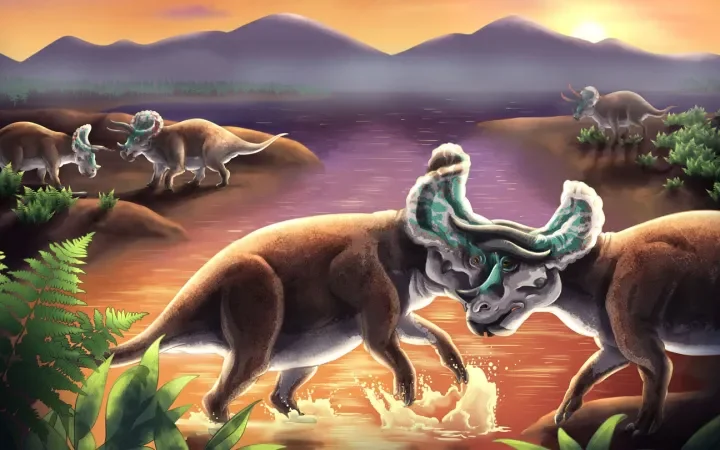 Horned dinosaurs’ weapons evolved to handle the forces of combat
 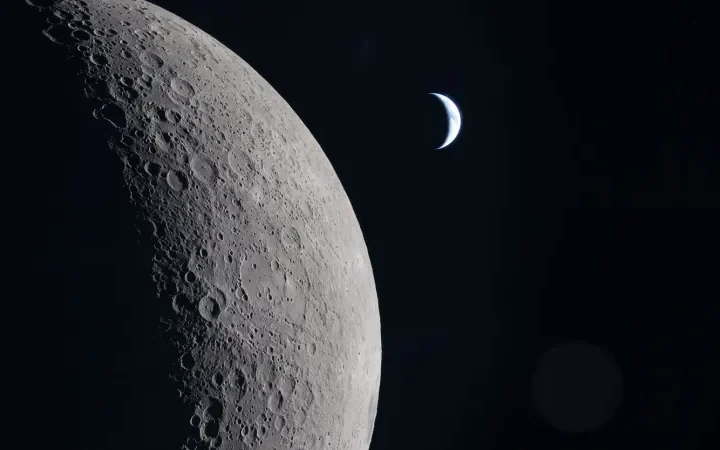 Artemis II results show how much science people can do at the moon
  Crossword: Time lines
  Many American diets may not include enough of this essential nutrient
  A telling hole in a Neandertal bone hints at a bitter end
  Brain implants are helping people who’ve lost their voice
  COP17: The world has a plan to save nature. Is it working?
  Flour sacks turned flood barriers: Gaza faces another winter without safe shelter
  WHO scales up Ebola readiness in 22 countries across three continents
  Ukraine: Civilian casualty rates among ‘deadliest’ in years, as energy attacks intensify